Get Full Government Meeting Transcripts, Videos, & Alerts Forever!
Get email alerts on the Renewable Energy Waste topic
No spam. Unsubscribe anytime.
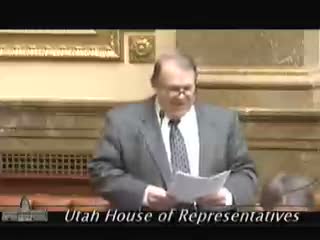
Utah House designates municipal solid waste a renewable energy source over health objections
Summary
After extended floor debate about emissions and public-health safeguards, the Utah House passed HB228 to add municipal solid waste to the state statutory definition of renewable energy, 68–4. Sponsors cited federal precedent and modern emissions controls; critics raised studies on older incinerators and urged strict permitting.
The Utah House passed House Bill 228 on Feb. 9, 2010, which adds "municipal solid waste" to Utah’s statutory definition of renewable energy in Titles 10 and 54. The vote was 68 in favor and 4 opposed.
Sponsor Representative Roger Barris argued the change would open the state to waste-to-energy technologies that capture energy from municipal solid waste rather than placing it in landfills. Barris cited federal and interstate precedent — including the 2005 Energy Policy Act, the Federal Power Act / PURPA, and U.S. Department of Energy classifications — and said 24 other states and the District of Columbia include municipal solid waste in renewable statutes. He told the House that waste-to-energy facilities can create steam and electricity, and that converting an existing steam stream to electrical generation could add roughly 15 megawatts — "enough for up to 12,000 homes," he said.
Several members raised air-quality and public-health concerns. One member referenced international studies of older incinerators that reported emissions of chemicals linked to cancer and neurological illness. Barris and supporters responded that those studies describe older facilities, not modern waste-to-energy plants; they cited EPA findings indicating that, when life-cycle impacts are considered, waste-to-energy can result in lower net greenhouse-gas emissions than some alternatives. Barris also cited modern controls — including continuous emissions monitoring and requirements to use MACT (maximum achievable control technology) — and said permitting would be managed by the Utah Division of Air Quality with public input.
Representative Mascaro and others offered local examples of landfill-gas capture and existing combustion-to-steam operations (the Wasatch Integrated Waste Management Facility supplying steam to Hill Air Force Base) to illustrate that parts of the technology are already used around Utah.
Opponents pressed on the inclusion of mixed or electronic waste in feedstocks and stressed the need for robust separation and recycling programs to reduce hazardous inputs to combustion processes. Sponsor responses noted that electronic-waste recycling legislation is being pursued separately and that the permitting process could require appropriate feedstock controls.
The bill passed 68–4 and will be transmitted to the Senate for consideration.