Get Full Government Meeting Transcripts, Videos, & Alerts Forever!
Get email alerts on the Federal Budget And Local Projects topic
No spam. Unsubscribe anytime.
Congressman Jason Chaffetz urges federal restraint, outlines Utah projects during House visit
Summary
U.S. Rep. Jason Chaffetz told the Utah House on Feb. 8, 2010 that rising federal spending and debt threaten national fiscal stability and highlighted federal projects and land bills affecting Utah, including an impending environmental impact statement for the Narrows and an NSA facility near Camp Williams.
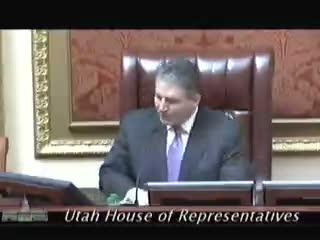
U.S. Rep. Jason Chaffetz addressed the Utah House of Representatives on Feb. 8, 2010, urging federal restraint on spending and outlining several federal projects and policy priorities for Utah. Chaffetz told lawmakers the federal budget and repeated debt-ceiling increases have raised national borrowing and interest costs, and he urged local leaders to press for restoring state control over some federal lands and programs.
Chaffetz told the chamber that when Democrats gained control of Congress in 2007 the federal budget was about $2.7 trillion and that recent increases have pushed it to roughly $3.8 trillion, producing steep growth in interest payments and overall federal employment. He said those trends create ‘‘difficult’’ long-term fiscal pressures and asserted the federal government is ‘‘encroaching’’ into areas better managed by states.
Putting those arguments in local terms, Chaffetz described ongoing projects and legislation relevant to Utah. He said an environmental impact statement for the Narrows project in Sanpete County was ‘‘literally at the printer’’ and expected within weeks, and he briefed members on an NSA facility near Camp Williams for which contractor bids were due in mid-February; he characterized the NSA build as a multibillion-dollar project that could bring substantial local employment. He also said his office was preparing land-disposal legislation to return certain Bureau of Land Management parcels to private ownership and that he was working with colleagues on a wolf-management bill to move wildlife decisions toward state control.
House members followed with questions about the federal debt and the stimulus-era funds. Representative Mascaro asked Chaffetz about national debt calculations and state-level impacts; Chaffetz reiterated the need to slow federal spending and offered numerical context, including day-to-day interest-cost estimates. The exchange remained an informational display of federal policy views rather than a vote or formal action.
Chaffetz closed by thanking the House and noting the priorities he and Utah’s delegation would pursue in Washington. The visit preceded routine legislative business and several floor votes later in the day.