Get Full Government Meeting Transcripts, Videos, & Alerts Forever!
Get email alerts on the Redistricting topic
No spam. Unsubscribe anytime.
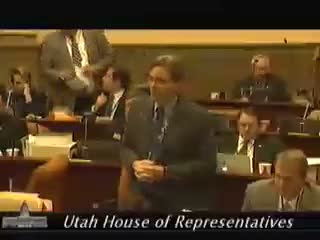
House adopts 19th substitute for congressional map after heated debate over splits
Summary
After extended floor debate about county and neighborhood splits and public input, the Utah House voted 50-19 to adopt the nineteenth substitute to Senate Bill 3,002, a congressional redistricting map the sponsor said balances rural and urban interests.
The Utah House of Representatives voted 50-19 on Oct. 17, 2011, to adopt the nineteenth substitute to Senate Bill 3,002, a revised congressional redistricting map that supporters said balances rural and urban areas while opponents said was rushed and split communities. Representative Ipsen, who sponsored the substitute on the floor, asked colleagues to support a map he described as the product of months of committee work and public input: “This map does that,” he said, arguing the substitute expanded a rural–urban mix and sought to keep as many communities whole as possible.
Why it matters: The adopted map will determine congressional district boundaries for the next decade, shaping which voters are grouped together for federal representation. Members raised procedural and representational concerns during the debate, and some argued the House had not given members or the public sufficient time to review changes introduced in the substitute.
What happened: Representative Ipsen introduced the nineteenth substitute and outlined changes that, he said, keep Salt Lake City largely intact, move parts of Davis County to different districts, and restore some Sanpete County territory to the Fourth Congressional District. Opponents said they had only minutes to examine the substitute and pointed to irregular, zig-zag boundaries within neighborhoods such as parts of Mill Creek Township and Olympus Cove. One member told the House, “This is a bill that we're going to be living with for 10 years,” underscoring the long-term impact of the decision.
Supporters defended the map as an improvement over the committee’s base map, saying it smooths problematic 'stair-stepping' lines through Salt Lake County and reduces the number of municipalities split. Representative Farris, a committee member, said the substitute reflected extensive vetting and public comment and created a better urban–rural mix. Representative Draxler cited constitutional constraints and the principle of equal-population districts, saying a zero-deviation target forces some splits: “You cannot achieve that with straight smooth lines in every community,” he said.
Formal action and next steps: The House adopted the nineteenth substitute by roll-call vote, 50 yes and 19 no. The chief clerk certified the printed bill and associated electronic materials and posted them to the legislature’s website; the substitute will be returned to the Senate for concurrence.
Members’ concerns and unanswered questions: Minority members repeatedly requested clearer rationales so they could explain their votes to constituents and pressed staff to show overlays, roads, and exact streets where boundaries fall. Several members asked staff to zoom to specific areas during floor debate to clarify whether cities such as Midvale, West Valley City, Cottonwood Heights, Draper and Sandy were split; the sponsor acknowledged small missed areas and apologized but said many compromises were driven by population math.
What’s next: The House will await the Senate’s response to the adopted nineteenth substitute; staff materials, printed text and electronic map files have been posted and certified by the chief clerk.