Get Full Government Meeting Transcripts, Videos, & Alerts Forever!
Get email alerts on the Energy topic
No spam. Unsubscribe anytime.
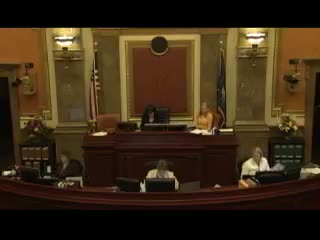
House approves bill creating interlocal vehicle-fueling authority after hours of debate
Summary
Lawmakers passed Senate Bill 275 to create an interlocal entity to promote alternative-fuel vehicle fleets and a cost-recovery mechanism for a gas corporation, after extended floor debate over PSC discretion and a $5 million annual cap on corporate participation.
Representative Todd Draxler, the House sponsor, urged members March 13 to back Senate Bill 275, saying the proposal creates an interlocal body to help local governments, school districts and other entities adopt alternative-fuel vehicles and build fueling infrastructure. "Cleaner air is not free," Draxler said, arguing the measure pairs public and private resources to convert large government fleets and reduce tailpipe pollution.
The bill establishes a governing board with executive-branch and legislative appointees, representatives from the Utah Association of Counties and the Utah League of Cities and Towns, a school-district designee, a public-transit representative, and an appointee from a natural-gas corporation. Draxler cited a corporate partner (identified in debate as Questar) that has contributed engineering hours and capital to gas infrastructure and said that, if approved by regulators, the cost implications to households would be small — he referenced "12¢ a month" as an illustrative estimate for a minimal rate impact.
Opponents pushed two main lines of objection. Representative King moved to change three occurrences of "shall" to "may" in the bill, arguing that the Public Service Commission (PSC) should retain discretion and not be micromanaged by statutory mandates. King said the PSC has expertise in rate-setting and should not be compelled to act in a specific way by legislative language. His amendment failed on a recorded vote, 23–50.
A separate amendment from Representative Hughes sought to remove a $5,000,000-per-calendar-year cap on corporate expenditures under the bill, arguing the cap would limit the program's reach; Hughes said the governor supported removing the cap. Supporters of the cap warned that eliminating it would create a de facto "blank check" and could shift costs to Questar customers via PSC-approved rate increases. Floor debate included questions about who would ultimately pay any approved expenditures; sponsors said costs would be borne by ratepayers if the PSC approved cost recovery.
Other lawmakers framed the dispute as a choice between sending a strong legislative signal to address air quality and preserving the PSC's deliberative, case-by-case ratemaking. Representative Tanner and others warned the measure shifts capital costs to ratepayers rather than shareholders. Representative Hughes urged members to view the bill as a framework to spur investment and noted supporting analyses that estimated small per-household impacts.
After multiple amendment votes and a motion to cut off further debate, the House approved SB 275 on a roll-call vote, 58–14. The bill will be returned to the Senate for further consideration.
The bill as amended includes provisions to form the interlocal entity, directs the PSC to initiate proceedings to evaluate and promote alternative-fuel measures, and provides a cost-recovery mechanism for a natural gas corporation subject to PSC findings and prudency review. Supporters said the bill targets large fleet conversions (school buses, transit and other heavy vehicles) where emissions reductions would be most substantial; critics warned of potential rate impacts and urged greater reliance on general-fund appropriations if the state wished to underwrite the conversion.
Next steps: the measure will go back to the Senate for further consideration and any concurrence action.