Get Full Government Meeting Transcripts, Videos, & Alerts Forever!
Get email alerts on the Legislative Process topic
No spam. Unsubscribe anytime.
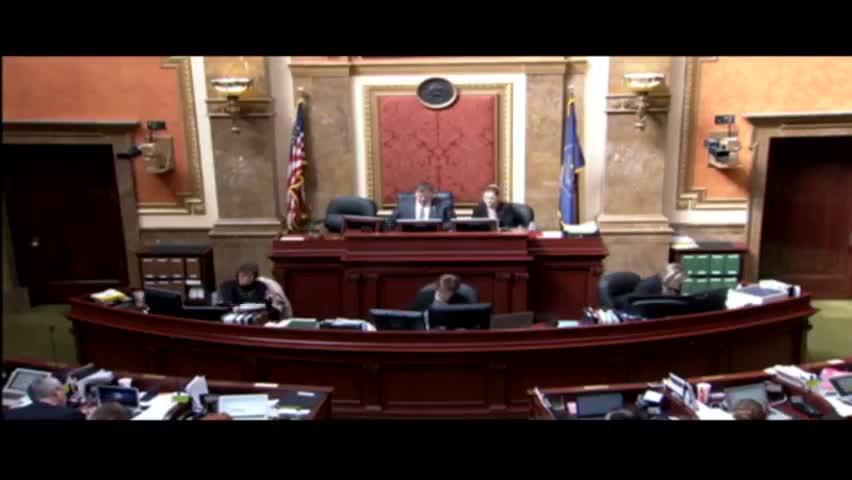
House clears consent and concurrence calendars, adopts committee reports and advances multiple bills to the Senate
Summary
On March 5 the Utah House cleared consent and concurrence calendars (including SB 213, HB 14, HB 299), adopted numerous committee reports, and placed several bills on the third‑reading and consent calendars; committee reports recommended multiple bills for further consideration or referral.
The Utah House completed routine floor business on March 5, 2015, adopting consent and concurrence calendar items and reading a batch of standing committee reports.
On the consent and concurrence calendars the House approved SB 213 (budgeting amendments for the State Office of Rehabilitation) with final passage recorded (64‑0 after a recorded 'I' vote), concurred with Senate amendments to Second Substitute HB 14 (appropriations limit and mathematical formula amendments, recorded 67‑0), and concurred with Senate amendments to HB 299 (attorney's lien amendments, recorded 66‑0). Second Substitute HB 89 (campaign contribution disclosure amendments) and First Substitute HB 388 (disaster recovery for local governments) also passed the House and will be transmitted to the Senate.
Clerks read a series of standing committee reports (Business & Labor; Education; Health & Human Services; Judiciary; Law Enforcement & Criminal Justice; Natural Resources; Retirement & Independent Entities; Transportation). Several bills were placed on the consent calendar or third‑reading calendars following favorable committee recommendations, and some substitutes were returned to Rules for fiscal review where a fiscal note remained pending.
Representative Stannard summarized SB 213 as a simple technical fix to address timing issues for non‑lapsing balances in the State Office of Rehabilitation. Representative Oda described First Substitute HB 388, which creates an optional revolving loan fund inside the disaster recovery fund to provide FEMA match loans for local governments; the bill passed unanimously (71‑0).
The House then moved into extended policy debate on other calendar items, including a high‑profile discussion and vote on HB 4 46 (covered in a separate article). The House recessed until 2:00 p.m. after completing the morning's scheduled business.
Next steps: Passed consent and concurrence items will be transmitted to the Senate; committee‑recommended bills remain on the House calendars according to the clerks' readings and any outstanding fiscal notes.