Get Full Government Meeting Transcripts, Videos, & Alerts Forever!
Get email alerts on the Prison Relocation topic
No spam. Unsubscribe anytime.
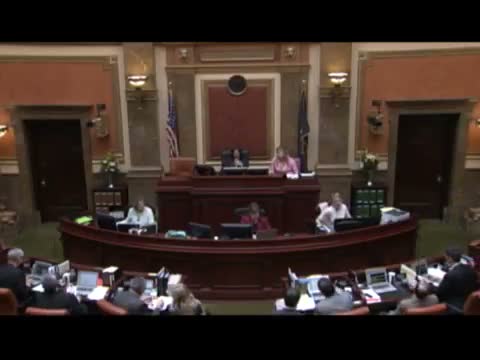
Utah House backs resolution to begin process of relocating Draper state prison
Summary
The Utah House on March 4 passed HCR 8, a concurrent resolution expressing intent to relocate the Draper state prison and establishing guiding principles for that work, after debate about oversight, privatization and community impacts. An amendment clarifying county–state housing arrangements was adopted.
The Utah House on March 4 approved a concurrent resolution (HCR 8) expressing the Legislature’s intent to begin planning for relocation of the Draper state prison, citing public safety, reduced recidivism and long‑term facility needs.
Representative Wilson, sponsor of the resolution, told colleagues the Prison Relocation and Development Authority had recommended moving the prison and that the Draper complex requires substantial repairs. “The state prison is surrounded by significant development,” Wilson said, and the facility is “falling apart, which has nearly $250,000,000 worth of repairs just to keep the walls up.”
The resolution directs that relocation be pursued with “careful, serious, and deliberate consideration,” taking into account criminal justice policy changes, programming to reduce recidivism and the fiscal implications of either rebuilding or relocating. Wilson said the Legislature will create a legislative commission to provide oversight, comprising seven legislators and two executive‑branch officials, to examine options and timing.
Members questioned safeguards and scope. Representative Cosgrove asked how the Legislature would provide oversight; Wilson replied a bill would replace the current authority with a legislative commission to dig into the issue. Representative Wheatley asked whether the resolution should explicitly identify best practices for rehabilitation and facility design; Wilson pointed to language in the resolution that states the new facility should be conducive to programming that reduces recidivism. Other members raised concerns about privatization: Wilson said there has been no study of private prisons in the authority’s work and it would be premature to assume privatization.
Representative Noel offered Amendment 1 (dated Feb. 28, 2014) to clarify relationships between the state and counties for housing inmates and to preserve flexibility; the House adopted the amendment. Representative Christiansen later moved to spread additional commission findings and numerical estimates onto the House Journal — including multi‑year cost and job projections drawn from the commission report — but that motion failed after a division vote.
The House approved HCR 8 after amendment by a recorded vote of 70–3. Representative Wilson said the measure provides guiding principles for future work, but that the detailed recommendations and implementation steps will require additional study and legislation. The resolution will be transmitted to the Senate for its consideration.
The House also debated next steps for oversight and timing: Wilson said relocation options ranged from an accelerated replacement by 2018 to a more gradual multiyear approach and that the commission’s forthcoming work will provide specifics.
The House’s action was procedural — HCR 8 expresses legislative intent and guiding principles but does not itself appropriate funds or authorize construction. Further legislation will be required to create the legislative commission and to fund any relocation or construction plan.