Get Full Government Meeting Transcripts, Videos, & Alerts Forever!
Get email alerts on the Early Childhood Education topic
No spam. Unsubscribe anytime.
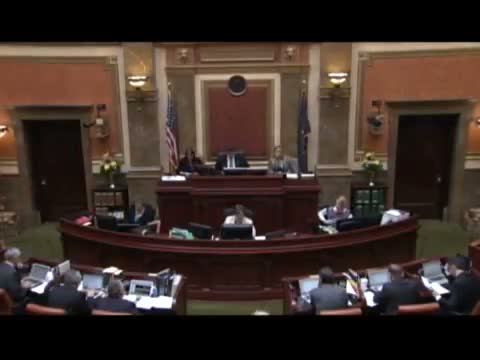
House passes Utah School Readiness Initiative after floor amendments and debate
Summary
The House passed House Bill 96 on Feb. 10, 2014, to create a results-based preschool program targeting low-income 3- and 4-year-olds; the program limits state exposure with a $15 million cap and uses independent evaluation before reimbursing private funders. The vote was 49-24.
Representative Jeff Hughes, sponsor of House Bill 96, told the House the proposal creates a targeted, results-based approach to preschool for at-risk 3- and 4-year-olds and would reimburse private providers only after independent verification of improved student outcomes.
The measure establishes a state board to vet curriculum and award grants, requires independent pre- and post-assessments to determine eligibility and results, and caps state exposure at $15,000,000. Hughes said the bill’s reimbursement model was designed to “leverage other people’s money” while avoiding long-term state encumbrances and that the legislature would only pay when a measurable cost avoidance for special education occurs. He added, “If it doesn't do what it's been touted to do, there is not a cost avoidance to the state, and we're not going to pay.”
Lawmakers adopted three floor amendments before the final vote. Amendment 1 made technical corrections to finance terms (renaming a special revenue fund to a restricted account). Amendment 2 replaced language that had required certain agencies to “report” with language that agencies will “annually share” data, clarifying the relationship between the newly formed board and the elected state board of education and avoiding a suggestion that the state board would be supervised by the new board. Amendment 3 narrowed the program's performance measure, focusing reimbursement eligibility on avoided special-education costs rather than broader remedial outcomes.
Supporters, including Representative Johnny Anderson, who declared a conflict of interest as a preschool provider, framed the bill as a cost-avoidance strategy that could reduce later special-education spending and expand access to high-quality early instruction for children who otherwise would be at high risk of requiring intensive services. Representative Arendt and others cited research and pilots that they said show long-term benefits when early childhood interventions are high-quality and targeted.
Opponents and skeptics raised implementation concerns. Representative Christianson and others questioned whether the new board's authority could unintentionally supersede the elected state board of education; sponsors said amendments clarify that the state board’s role is to share data and identify eligible LEAs, not to cede constitutional authority. Members also pressed for detail on the bill’s contracting and oversight: HB96 permits private or philanthropic investors to provide up-front capital but caps the investor return at 5% and requires independent evaluation before state reimbursement. Representative McKay urged caution and suggested more time to study the concept, and Representative Byrd and others raised concerns about investor incentives, the length of time investors would lock up funds and whether adequate safeguards would attract capital.
The bill includes several specific safeguards: parental consent for data-sharing with independent evaluators, a third-party research institution selected through an RFP to vet curriculum and assessments, class-size and adult-to-student guidance for LEA-run programs, and a post-performance reimbursement structure that requires demonstrable avoidance of special-education costs.
Representative Hughes said a current proof-of-concept pilot with roughly 600 children informed the bill’s design; he emphasized that if the model fails the state pays nothing. After extended debate and adoption of the three amendments, the House voted on HB96. The final tally was 49 yeas and 24 nays; HB96 passed the House and was transmitted to the Senate for further consideration.
Next steps: HB96 will proceed to the Senate, where it may be amended again in committee or on the floor. Sponsors noted the bill’s details — including evaluator selection, contract terms, and implementation protocols — will be fleshed out in the subsequent process and in related procurement documents.