Get Full Government Meeting Transcripts, Videos, & Alerts Forever!
Get email alerts on the Police Pursuit Policy topic
No spam. Unsubscribe anytime.
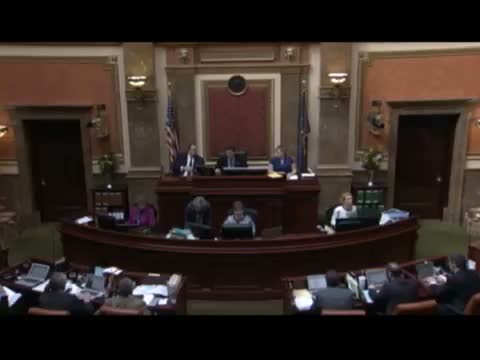
House approves narrow duty-of-care carve-out for pursuits after court ruling
Summary
The Utah House passed House Bill 20 on Feb. 4, 2014, a narrowly drawn change to civil liability for operators of authorized emergency vehicles during pursuits, after floor amendments that clarified that officers acting outside applicable pursuit policy or with actual intent to harm are not covered. The bill passed 64–10 and will go to the Senate.
The Utah House on Feb. 4 approved House Bill 20, a narrowly tailored change to civil liability that limits an operator of an authorized emergency vehicle’s duty of care to a fleeing suspect when the operator acts within applicable pursuit policy and without intent to harm. Representative Dee, who sponsored the bill, told the House the change responds to a court decision and is not intended to provide blanket immunity for misconduct.
The bill was presented as a response to a court case the sponsor referenced as Tory v. State of Utah; the sponsor said the decision left an officer personally liable in a pursuit and that the Legislature intended to clarify that officers who act within policy should not face individual liability in those circumstances. Representative Dee said the measure does not remove remedies for innocent bystanders and does not shield conduct outside an agency’s pursuit policy.
Floor debate focused on where the line should be drawn between protecting officers who follow policy and preserving remedies for injured nonparticipants. Representative King argued the bill as originally drafted risked denying remedies to innocent passengers or victims and urged case-by-case adjudication. "My daughter, my 16-year-old daughter has the misfortune of going out on a date with an individual who has a warrant out for his arrest ... My daughter and I have no remedy," King said in a floor illustration to underline the potential effect on uninvolved passengers unless exceptions are written carefully.
Law-enforcement supporters described a chilling effect after the cited court ruling, saying officers may hesitate to conduct legitimate pursuits if they face greater personal liability. Representative Greenwood, speaking from a former street‑cop perspective, said modern pursuit policies and training are widespread and that the bill addresses a narrow problem the court highlighted.
During floor consideration the House adopted several amendments. Representative Green offered an amendment to change language on line 86 so that, where a passenger is deceased or incapacitated, an estate or other third party may prove involuntary presence by a preponderance of the evidence; the House adopted that amendment. Representative McKiff later offered clarifying language that created subparagraphs addressing (a) involuntary presence in a vehicle and (b) involuntary participation in evading or fleeing; proponents said that edit was worked with the attorney general's office to ensure estates could pursue a wrongful-death claim where appropriate. Representative Tanner moved and the House adopted an amendment clarifying that an operator acting "not following applicable pursuit policy" is not covered by the carve-out, addressing concerns about officers who act outside training or agency rules.
Sponsors stressed multiple times that the bill does not protect officers who act with actual intent to cause harm or who act outside written agency policy. The sponsor pointed to bill language stating an operator remains obligated to act as a reasonably prudent emergency vehicle operator in like circumstances and that the carve-out applies only when the officer is operating within policy.
After debate, the House voted to pass House Bill 20 with a final tally of 64 yea and 10 nay votes. The bill will be transmitted to the Utah Senate for further consideration.
The House record identifies the bill sponsor in the floor discussion as Representative Dee (appearing in the record alternately as "Representative D." in some lines). The transcript includes the cited court case name as presented on the floor and multiple floor speakers, whose remarks are quoted above from the House record.
What's next: House Bill 20 will be sent to the Senate for its consideration; any further amendments or committee referrals there could modify the language before final enactment.