Get Full Government Meeting Transcripts, Videos, & Alerts Forever!
Get email alerts on the Courts State Of System topic
No spam. Unsubscribe anytime.
Utah chief justice cites 93% court-user satisfaction, urges focus on access and technology
Summary
Chief Justice Matthew B. Durand told the Utah House that a statewide court-user survey found 93% overall satisfaction and highlighted initiatives on accessibility, electronic records and transparency that reduced costs and improved service.
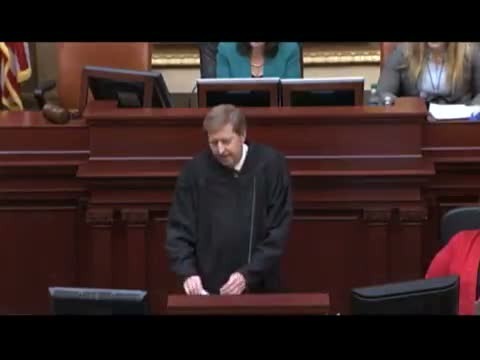
Chief Justice Matthew B. Durand told the Utah House that a recent statewide courthouse user survey found ‘‘That number is 93,’’ meaning 93 percent of respondents said they were satisfied with their court experience.
Durand opened his appearance in the Committee of the Whole with a personal anecdote and used the statewide survey results to illustrate what he called ‘‘procedural fairness’’ — the combination of voice, neutrality and respect that he said helps litigants feel heard and treated fairly regardless of case outcomes.
Why it matters: Durand framed the court system’s work as addressing nearly 900,000 cases last year across criminal, civil, juvenile and family dockets and said procedural fairness helps preserve public confidence even when outcomes are adverse. He told legislators that accessibility, efficiency and transparency have been central goals of recent reforms.
Durand cited a series of concrete access initiatives: a statewide court self-help center for phone, email and text assistance that he said helped about 16,000 people last year, and an online court assistance program (OCAP) that produced over 60,000 fillable documents. He said the courts provided translators for 47 languages and logged nearly 20,000 hours of translation to serve non-English speakers.
On efficiency, Durand said Utah has a statewide electronic court record system that combines e-filing, e-payments and e-warrants with real-time online access to dockets and documents. He said that shift increased staff productivity and allowed an ‘‘approximately 8%’’ reduction in the court clerk workforce over two years, producing personnel cost savings and reducing physical storage needs.
Durand gave a local example: Summit County freed file-storage space by moving records online and used that space to remodel and add a needed courtroom rather than build an entirely new facility.
The chief justice also emphasized transparency. He said the courts publish performance measures publicly, that judicial performance evaluations are made available to voters, and that, since April 1 of last year, media have been permitted to use video cameras in courtrooms — with more than 100 district, juvenile and justice-court proceedings videotaped and at least one trial broadcast in real time.
Durand closed by asking legislators to bring ideas to the Judicial Council and to continue working with the courts to identify improvements. ‘‘We are proud of the success of our new business model and of our ability to use existing resources to provide increased access, efficiency, and transparency,’’ he said.
The House returned to its regular session after the justices’ appearance.