Get Full Government Meeting Transcripts, Videos, & Alerts Forever!
Get email alerts on the Legislation Votes topic
No spam. Unsubscribe anytime.
House passes a broad slate of Senate bills; several measures fail
Summary
On March 12, 2015, the Utah House approved a large group of Senate bills and house substitutes — including veterans courts, antitrust investigation confidentiality, ABLE accounts for disabled savers, and suicide-prevention funding — while rejecting bills on journeyman licensing exemptions and a controversial historic-district threshold.
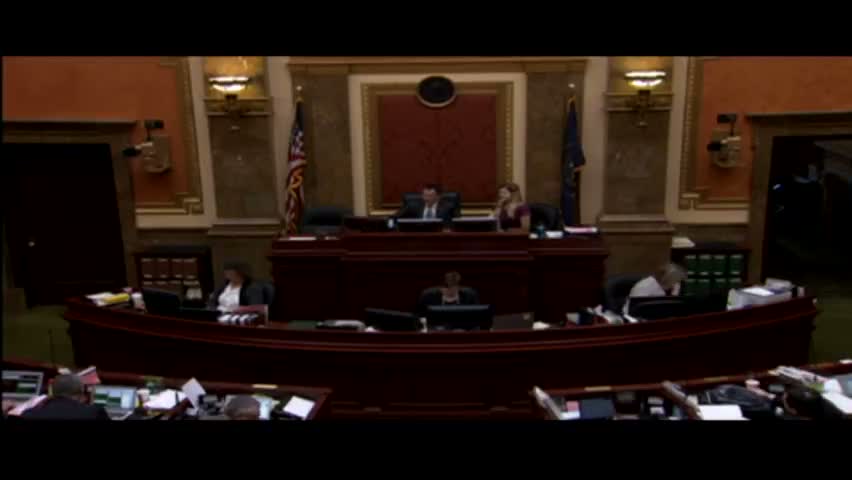
The Utah House of Representatives completed a rapid series of votes during its Day 45 session on March 12, 2015, approving multiple Senate bills and substitutes while rejecting others after debate. The session produced several enacted measures and a few notable defeats.
Among the bills the House passed and returned to the Senate were Senate Bill 214 (Veterans Court), which the sponsor said leverages Veterans Administration services so the state has no fiscal exposure; the body approved the measure 58–1. Senate Bill 257 (antitrust amendments), uncircled and presented on the floor, passed unanimously (66–0) after a House sponsor said it facilitates investigations by allowing confidentiality agreements in appropriate cases. The House also concurred with Senate amendments on bills addressing interlocal agreements (first substitute HB251, 66–0) and the student-privacy study (first substitute HB68, 69–0).
On tax and education measures, the House amended and passed Senate Bill 250 (income tax revisions) as amended (vote recorded 68–0 on the amended measure). Several education-related substitutes were approved after sponsors described coordination and technical fixes.
Lawmakers approved implementation of the federal ABLE Act locally by passing first substitute Senate Bill 292 (Achieving a Better Life Experience program and tax credits); after substitution to align the fiscal note and add a processing fee, the second substitute passed (final recorded tally 50–18). Representatives described ABLE accounts as tax-advantaged savings vehicles for qualifying disabled individuals, including a Medicaid-payback provision on a beneficiary’s death.
Not every measure before the chamber passed. Second substitute Senate Bill 242 (licensing amendments) — which would remove a small-jobs exemption allowing journeyman electricians and plumbers to perform certain work without a master contractor’s license — was rejected overwhelmingly (4–66); opponents argued journeymen have substantial training and the change would unnecessarily restrict access. A contested measure on historic districts (second substitute SB293), which would have raised the final approval threshold for creating a local historic district, failed after prolonged debate (31–38). Sponsors of the historic-district bill framed it as a protective measure for private property rights; detractors said the proposed 75 percent final-approval threshold would be impractical and asked for interim study.
The House also approved bills establishing administrative procedures for environmental permit reviews (first substitute SB282), addressed solid-fuel-burning amendments (HB396), modified campaign contribution penalty language, and passed suicide-prevention funding reallocations (second substitute HB364), among others. Where final vote tallies were recorded on the floor, those counts are included above.
The House recessed at the end of the floor session until 2 p.m., concluding a packed day of floor action.