Get Full Government Meeting Transcripts, Videos, & Alerts Forever!
Get email alerts on the Legislation topic
No spam. Unsubscribe anytime.
Utah House advances package of bills on caller-ID spoofing, school benefits, human trafficking and more
Summary
The Utah House on Feb. 24, 2015, adopted a series of committee reports and passed multiple bills, including measures that make caller-ID spoofing a state crime, clarify school post-employment health benefit funding, expand human-trafficking statutes for minors and permit limited use of unclaimed tissue for recovery dog training.
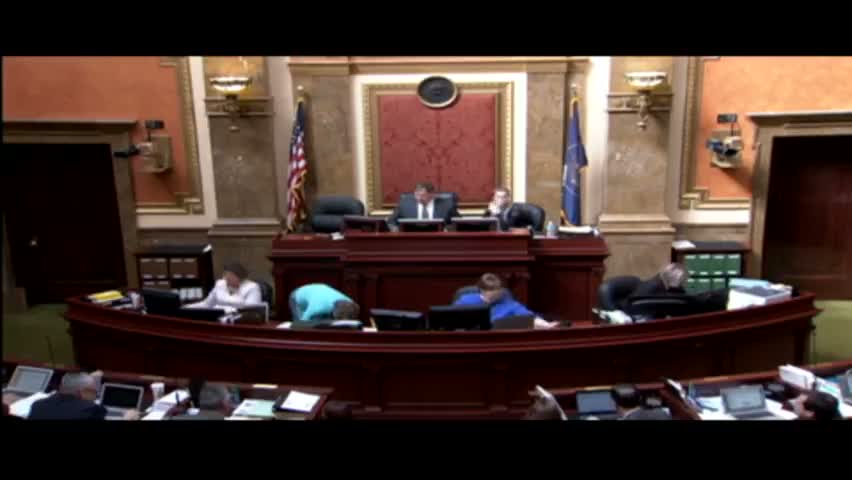
The Utah House of Representatives passed a wide-ranging package of bills on Feb. 24, 2015, moving measures on criminal conduct, school pension liabilities, public-health screenings and victim-protection to the Senate or toward enactment.
Representative Lifford, sponsor of the bill targeting caller-ID and text-message spoofing, told colleagues the practice can be dangerous and sometimes leads to “swatting” incidents that put law enforcement and private citizens at risk. “This is a serious crime that’s happening nationwide,” Lifford said, and added the change is intended to fill an enforcement gap where federal authorities may not act on smaller-scale spoofing. The House adopted an amendment proposed by the sponsor and approved final passage of the bill to make misrepresentation of telephone and text identification a state crime (final passage reported in the record).
The chamber also approved legislation addressing school districts’ other post-employment benefits (OPEB). Representative Elison described the measure as a multi-year effort to shore up pension accounting and said “currently, it’s about $200,000,000” in OPEB unfunded liabilities across districts. The bill requires steps to bring districts toward required contributions and gives districts a multi-year window to address shortfalls; members were told the measure aims to preserve promised benefits for current employees without imposing unworkable immediate cuts. The House recorded passage of the measure.
Other notable actions included: passage of substitute language to allow limited use of small tissue samples from unclaimed bodies for training search-and-recovery (recovery) dogs after committee refinement; Representative Pitcher described the change as enabling practical training tools for volunteers who assist in disaster and recovery missions. Representative King framed amendments to the human-trafficking statute as strengthening prosecutorial tools for cases involving minors, calling human trafficking “modern day slavery,” and the House approved the amendment and final passage as recorded.
The House also: concurred with Senate amendments on multiple bills (including HB97 and HB121), passed first-substitute bills on vision screening in schools and hearing-instrument specialist consumer protections, and advanced assessment-area financing reforms. Several committee reports were adopted at the start of the session; the House recessed at mid-afternoon and planned to reconvene at 2:00 p.m.
Votes at a glance (as recorded on the House floor): - HB97 (election of officials of new municipalities) — concurrence with Senate amendments, final passage reported in the record. - First substitute HB98 (association amendments) — concurrence and final passage (vote tally recorded in the House journal). - HB121 (Interstate Medical Licensure Compact) — concurrence with Senate amendment and final passage (vote recorded). - HB112 (first substitute, hearing instrument specialist amendments) — passed (57 yes, 14 no recorded). - HB214 (Misrepresentation of telephone and text identification) — amendment adopted and final passage (71 yes, 1 no recorded). - HB145 (vulnerable adult worker amendments) — concurrence adopted and final passage (67 yes, 0 no recorded). - HB208 (School district post-employment health insurance benefits) — passed (68 yes, 4 no recorded). - Second substitute HB190 (assessment area act modifications) — passed (60 yes, 13 no recorded). - First substitute HB237 (vision screening amendments) — passed (73 yes, 0 no recorded). - Third substitute HB173 (recovery dog training amendments) — passed (74 yes, 11 no recorded). - HB252 (human trafficking amendments) — passed (75 yes, 0 no recorded). (Where the floor record was ambiguous about an exact tally in the transcript, the House journal provides the authoritative record.)
What happened next: bills that passed the House will be forwarded to the Senate for consideration as appropriate; the House recessed until 2:00 p.m. and planned additional business later in the day.