Get Full Government Meeting Transcripts, Videos, & Alerts Forever!
Get email alerts on the Legislative Roundup topic
No spam. Unsubscribe anytime.
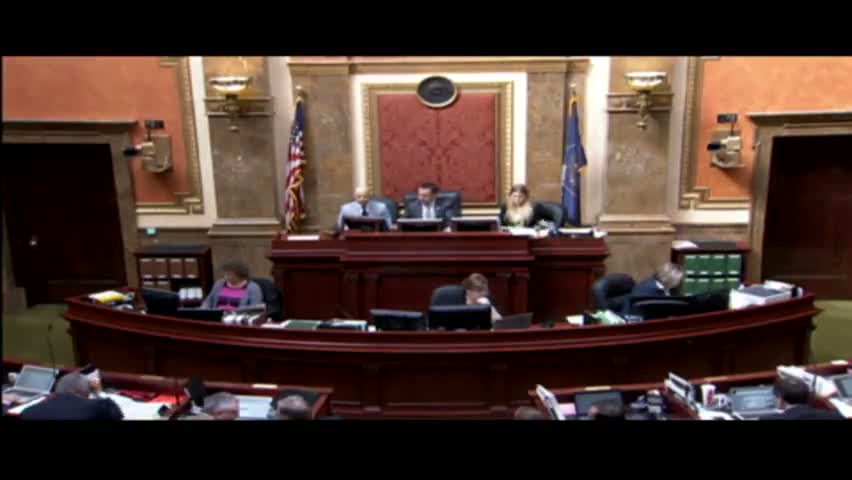
House passes package of bills on veterans, National Guard funding, nonprofit reporting and natural resources
Summary
On March 3 the Utah House approved several bills including measures to change veterans nursing home advisory boards, allow temporary emergency loans for the National Guard, make Guard funds non‑lapsing, clarify nonprofit audit thresholds, and amend oil and gas drilling unit rules.
The Utah House of Representatives advanced a group of bills on March 3 covering veterans’ nursing homes, emergency funding for disaster response, National Guard funding, nonprofit financial reporting, background checks for state accountants, and natural resource issues.
Representative Val Peterson introduced a package of measures affecting the Utah National Guard and veterans’ nursing homes. First substitute HB 381 (Veterans Affairs Amendments) shifts appointment authority for veterans nursing‑home advisory boards from the governor to the executive director of Military and Veterans Affairs and revises board membership requirements; the measure passed the House 70–0.
Representative Oda guided first substitute HB 357 (Emergency Services Account Loan Amendments), explaining the bill would allow the state’s disaster recovery account to make temporary loans to state agencies — primarily the National Guard — deployed to assist neighboring states in disasters, with reimbursement to the account once billing is complete. The House uncircled and passed HB 357, 68–0.
Representative Val Peterson also presented HB 382 to make Utah National Guard funds non‑lapsing so that the funds remain available year to year; HB 382 passed 70–0.
On accountability and finance, Representative DeCaro described third substitute SB 132 (Fiscal Requirements for Local Governments and Nonprofits) as the product of stakeholder negotiations. The bill requires nonprofits receiving public funds to submit financial reports to the state auditor with tiered thresholds: online filing below $100,000; compiled statements for $100,000–$350,000; reviewed statements for $350,000–$750,000; and audited statements for amounts over $750,000. The House passed the bill 64–5.
Representative Eliason summarized SB 159, which permits (but does not require) the Division of Finance to conduct background or credit checks for executive‑branch employees with significant accounting responsibilities; the bill was adopted as amended with a roll call (66–0).
Representative Chu described SB 188 to clarify the board of oil, gas and mining’s authority to allow more than one well per drilling unit in certain circumstances to enable horizontal drilling; the House passed it 69–0.
Votes at a glance: HB 381 — 70–0 (passed); HB 357 — 68–0 (passed); HB 382 — 70–0 (passed); SB 132 — 64–5 (passed); SB 159 — 66–0 (passed); SB 188 — 69–0 (passed).
What’s next: All passed bills will be transmitted to the Senate for its consideration or signature as appropriate.