Get Full Government Meeting Transcripts, Videos, & Alerts Forever!
Get email alerts on the Criminal Justice Reform topic
No spam. Unsubscribe anytime.
House passes broad criminal-justice reform package focusing on treatment, risk assessments and reduced penalties
Summary
First substitute HB348 passed 72-3 after floor debate and an amendment. Sponsor Representative Hutchings said the package prioritizes risk-and-needs assessments, reduced penalties for some drug offenses, new treatment and supervision resources, and staged implementation with outcome measures.
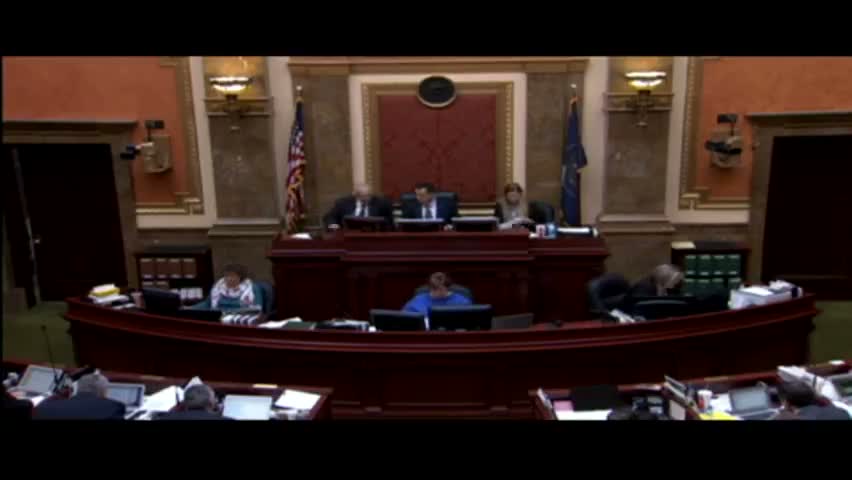
Representative Hutchings, sponsor of first substitute HB348, successfully guided a wide-ranging criminal-justice reform package through the Utah House on March 3, 2015, telling colleagues the measures aim to identify why people commit crimes and match sanctions and treatment to those causes.
Hutchings opened the floor presentation by moving amendment number 3 and describing the bill as a package of reforms that would introduce more rigorous needs-and-risk assessments at arrest and sentencing, reduce penalties for certain drug-related offenses, expand treatment opportunities and enhanced supervision, and establish performance and outcome measures. He said stakeholders including the Commission on Criminal and Juvenile Justice (CCJJ), prosecutors, sheriffs, courts, the board of pardons and national groups such as the Pew Charitable Trusts helped shape the proposal.
Lawmakers asked detailed questions about funding, supervision of misdemeanors and the role of Medicaid expansion in financing community treatment. Hutchings and appropriations supporters said about $15 million had been identified as part of the appropriation process for the package, with roughly half intended for infrastructure (personnel, training, systems) and the remainder for treatment dollars; sponsor also noted a specific budget request of roughly $4.5 million targeted for treatment through the Division of Substance Abuse and Mental Health. Hutchings emphasized that while that funding would have an impact, it would not fully solve treatment capacity needs and implementation would be staged through the year with separate effective dates.
Several members spoke in support, describing the bill as a chance to reduce recidivism by addressing substance abuse and mental illness rather than imposing longer terms alone. Representative Cutler recounted experiences at a Salt Lake County women’s facility and urged earlier interventions; Representative Hollins called for plans that keep people in treatment and connected to services after release. Representative Brian King and others pressed on fiscal details; Hutchings and committee members said the package included technical clarifications and that the group had reached broad agreement after months of stakeholder work.
On policy specifics, Hutchings said some third-degree drug offenses would be reduced in classification (for example, certain third-degree charges down to class A; some class A down to class B) and that enhanced supervision and program checklists would create standards the state could use to evaluate treatment providers. He said programs that did not meet mandated best practices would not receive state diversion or payment.
Before the final vote the House carried a motion to end debate. First substitute HB348, including amendment 3, passed the House 72-3 and was referred to the Senate.
What happens next: the bill includes staged implementation dates and outcome measures; sponsors said they expect further work on supervision models for misdemeanors and possible statutory follow-up next year if needed. Appropriations and program design decisions will determine how many people can be diverted to community treatment versus traditional incarceration.
Votes and formal actions: the House adopted amendment number 3 (moved by Representative Hutchings), then voted to pass first substitute HB348, 72 yes to 3 no. The bill was referred to the Senate for consideration.
Sources: Floor presentation and exchanges on March 3, 2015 (House floor session).