Get Full Government Meeting Transcripts, Videos, & Alerts Forever!
Get email alerts on the Floor Votes topic
No spam. Unsubscribe anytime.
Utah House passes wide set of bills including state parks camping, livestock penalties and EMS assessment
Summary
The Utah House on Feb. 25 approved a slate of bills on first and third reading, including adding camping to Utah State Parks’ mission, increasing penalties and restitution for livestock destruction, and creating a $25 ambulance assessment to draw down federal funds; multiple bills were transmitted to the Senate.
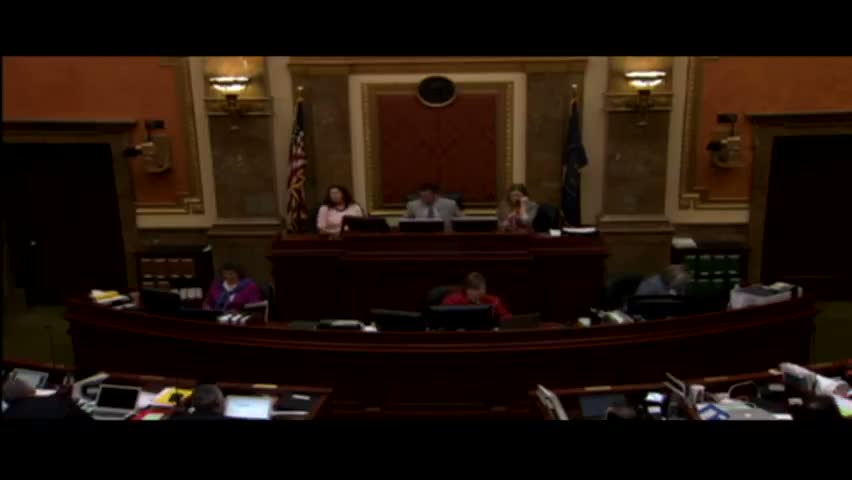
Salt Lake City — The Utah House of Representatives voted on Feb. 25 to advance a series of measures spanning state parks, livestock protections, reporting requirements, procurement rules and emergency medical services funding.
Among the bills passed, House Bill 259, sponsored in the House by Representative Powell, adds "camping" to the official mission of Utah State Parks to ensure camping is explicitly prioritized in park management. The bill passed the House by voice and a recorded vote of 68–0 and will be transmitted to the Senate for further consideration.
House Bill 317, presented by Representative Nelson, increases penalties and adds restitution for the destruction of livestock, including value for offspring; the House approved the measure 68–1 and will send it to the Senate.
Senate Bill 168 (house sponsor Representative McKay) was amended to allow charter schools to be used for civic events under the same civic center provisions that apply to public schools. The substitute passed the House 67–3 and will return to the Senate.
The House also approved Senate Bill 112, which expands public reporting requirements to include subdivisions of subdivisions (for example, university-affiliated entities), by a 69–0 vote. First substitute Senate Bill 121, adjusting procurement code to allow safety program considerations during procurement, passed 70–0.
On consumer protections and financial oversight, the House passed Senate Bill 120, providing oversight for reverse mortgages, 65–0.
On funding for ambulance services, Representative Wilson presented Senate Bill 172, which creates a $25 assessment per ambulance transport to a hospital to generate restricted state funds that, when matched with federal programs, are intended to support ambulance providers. The sponsor cited a fiscal note estimating the $25 fee would generate about $3,000,000 in restricted funds and draw down roughly $7.5 million in federal matching funds. The measure passed the House 69–2 and will be returned to the Senate.
Several bills were circled (set aside to return to later floor time), including substitutes for education and graduation-related bills. First substitute House Bill 251, amending the Interlocal Cooperation Act to standardize fiscal and governance procedures for interlocal agencies and require public notice and approval steps for board compensation, passed 68–0 and will be referred to the Senate.
Many other bills and committee reports were placed on calendars or referred to standing committees for further work. Where recorded vote tallies were announced on the floor, this article lists the House totals as read aloud by the Speaker or reading clerk.
The House recessed until 2:00 p.m.