Get Full Government Meeting Transcripts, Videos, & Alerts Forever!
Get email alerts on the Legislative Votes And Committee Reports topic
No spam. Unsubscribe anytime.
House advances a slate of bills on third reading and adopts multiple committee reports
Summary
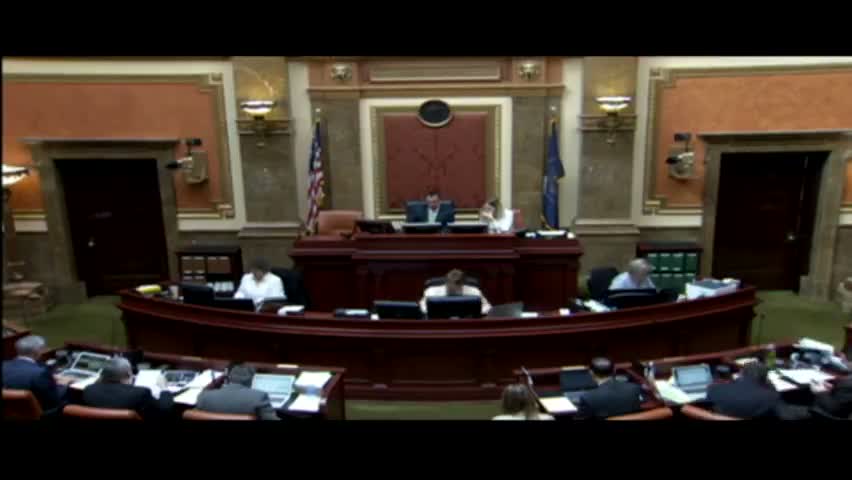
On Feb. 2, 2015 the Utah House passed a series of bills on third reading (including HB 75, HB 78, HB 106, HB 125, HB 53, HB 14, HB 103, HB 111, HJR 6, HJR 4) and adopted several standing committee reports assigning new bills to committees.
The Utah House moved a package of bills through third reading, adopted standing committee reports and handled routine chamber business during its Feb. 2 floor session.
Key bills passed and floor actions:
House Bill 75 (Children's Health Insurance Program amendments): Representative Hawkes said the bill clarifies CHIP advisory board size and relaxes a five‑year RFP requirement to allow current providers to remain under contract while agencies review procurements. The House voted 71–1 in favor and referred the bill to the Senate.
House Bill 78 (Generator site access permits amendments): Sponsor Representative D. described audit‑driven cleanup and noted limitations imposed by the Nuclear Regulatory Commission; the House passed the bill 73–0.
House Bill 106 (Wildlife amendments): Representative Schultz presented technical corrections to bring commercial hunting areas in line with statewide hunting rules and added trial‑hunting authorizations; HB 106 passed 72–1 and will go to the Senate.
House Bill 125 (Fishing license amendments): Representative Cutler explained the change allowing organized groups to include 14‑ and 15‑year‑olds (previously limited to younger ages); HB 125 passed 74–0.
House Bill 53 (Local government residential reimbursement authority): Representative Anderson said the bill allows counties of the first class to create reimbursement funds to help homeowners resolve title defects (funds to be repaid and secured by lien). HB 53 passed 72–0.
House Bill 14 (Appropriations limit formula amendments): Representative Hall explained this technical conversion of text to a formula requested by the state auditor; HB 14 passed 73–0.
House Bill 103 (Taxation of property amendments): The sponsor described adding considerations (for example, prior radioactive waste) when assessors determine fair market value under privilege tax rules; HB 103 passed 74–0.
House Bill 111 (Payment of property tax amendments): Representative Webb said the bill prevents public officials from requiring payment of property taxes before the statutory due date; HB 111 passed 74–0.
House Joint Resolution 6 (Reimbursement for legislative training days): Representative Dunigan said the resolution would permit up to four reimbursable training days (expenses only) subject to legislative oversight; HJR 6 passed 71–2.
House Joint Resolution 4 (Conference committee transparency): Representative Romero said the measure requires listing the name and vote of each conference committee member on the report; HJR 4 passed 73–0.
Committee business and procedural items: The House adopted multiple standing committee reports (economic development, government operations, political subdivisions, retirement and independent entities) and assigned a set of bills to committees for further consideration. Several bills were circled for later action and some were placed on the consent calendar.
Other floor business: Representative (speaker 6) introduced 75 fifth graders from Cottonwood Elementary; Representative Steve Handy announced a chiefs‑of‑police luncheon and a family event at the Museum of Natural History. The House adjourned to reconvene Tuesday, Feb. 3 at 11 a.m.
Vote-at-a-glance (selected third‑reading tallies announced on the floor): HB 75 — 71 yes, 1 no (passed); HB 78 — 73 yes, 0 no (passed); HB 106 — 72 yes, 1 no (passed); HB 125 — 74 yes, 0 no (passed); HB 53 — 72 yes, 0 no (passed); HB 14 — 73 yes, 0 no (passed); HB 103 — 74 yes, 0 no (passed); HB 111 — 74 yes, 0 no (passed); HJR 6 — 71 yes, 2 no (passed); HJR 4 — 73 yes, 0 no (passed).
What happens next: Passed bills will be transmitted to the Utah Senate for consideration; bills placed on the consent calendar or circled will be scheduled for future floor action or committee amendment.