Get Full Government Meeting Transcripts, Videos, & Alerts Forever!
Get email alerts on the Judiciary topic
No spam. Unsubscribe anytime.
Utah chief justice urges treatment investments as Justice Reinvestment Initiative reshapes courts
Summary
Chief Justice Matthew B. Durant told the Utah House that Justice Reinvestment Initiative reforms are a major change for the criminal justice system but risk worsening outcomes unless adequate substance‑abuse and mental‑health treatment is funded; he also outlined proposals on indigent defense, pretrial release, and access to legal services.
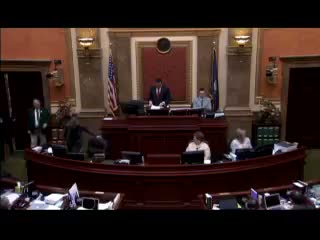
Chief Justice Matthew B. Durant told the Utah House on the floor that the Justice Reinvestment Initiative (JRI) represents “the most significant change in Utah criminal justice policy in decades,” but warned the reforms will fail without expanded treatment resources for people with substance‑use and mental‑health needs.
Durant opened by thanking colleagues and introducing the justices seated in the gallery. He said the judiciary has focused this year on four initiatives: implementing JRI, strengthening indigent defense, improving pretrial release practices and expanding access to civil legal services. On JRI, Durant said the law reduced incarceration and supervision but was conceived as a “complete package” that also depends on treatment programs and funding. “If treatment is unavailable, not only will the system fail to improve, it will likely worsen,” Durant said.
The chief justice described a multi‑year Judicial Council study on indigent defense that identified three problems (lack of oversight, inconsistent contracting practices and variable procedures) and recommended creating a statewide representative commission to set data standards, monitor counsel appointment and improve uniform procedures. He said Senator Weiler and Representative McKay plan to introduce legislation this session to create the recommended indigent defense commission.
On pretrial release, Durant said Utah should adopt evidence‑based practices used elsewhere: validated short risk assessments, quicker release for low‑risk defendants, tools to identify those who are truly dangerous, and processes that avoid making wealth the deciding factor in pretrial liberty. He said outside Salt Lake County Utah generally has not adopted these tools and that the Judicial Council’s study committee recommended 12 measures ranging from a presumption in favor of release without financial conditions to statewide risk assessments.
Durant also described a Supreme Court task force recommendation to allow specially trained nonlawyers to provide limited legal services in debt collection, landlord‑tenant and family law as licensed paralegal practitioners, with standards for education, certification and supervision. He framed that as a market‑driven approach to expand access to legal help where attorneys are unavailable.
The address closed with court performance metrics Durant cited: a reduction in average case age in district courts and operational efficiencies achieved with fewer staff. He asked the Legislature to consider funding for two additional judges — a Fourth District juvenile judge and a Fifth District district judge — to address persistent workload imbalances. Durant ended by thanking the Legislature for past steps on judicial compensation and urging attention to the unfinished treatment and access elements of JRI.
The House received the address in committee of the whole and later returned to regular session without taking any formal action on the court’s requests during this floor period.