Get Full Government Meeting Transcripts, Videos, & Alerts Forever!
Get email alerts on the Health Insurance topic
No spam. Unsubscribe anytime.
House approves three‑year pilot to study coverage parity for amino‑acid medical formula
Summary
The Utah House on March 6 approved a second substitute to H.B. 400 creating a three‑year pilot inside the Public Employee Health Plan to study oral coverage parity for amino‑acid‑based medical formula for conditions that prevent absorption of whole proteins. Lawmakers said the pilot will protect PEHP reserves while evaluating costs and usage.
The Utah House voted to approve a three‑year pilot study aimed at understanding insurance coverage for amino‑acid‑based medical formulas used by patients who cannot absorb intact proteins.
Representative Red, sponsor of the second substitute to House Bill 400, told colleagues the substitute converts a coverage‑parity bill into a time‑limited pilot that would be administered inside the Public Employee Health Plan (PEHP) and cover up to 62,000 lives. "This bill has to do with problems that some of our constituents have with digesting proteins," the sponsor said, describing conditions such as eosinophilic gastritis and short bowel syndrome and stressing that the formula can be life‑sustaining.
Supporters said oral administration of amino‑acid formula can cost families upward of $10,000 a year when not covered; the substitute directs PEHP to run the pilot to determine how often patients use orally administered formula versus feeding tubes and to report results that could guide future policy. Amendment No. 3, adopted before final passage, specifies that funding for the pilot will come from PEHP reserves (the public employee state risk pool reserve) so that the state employee health plans are not put at risk.
Representative Red said state actuaries and PEHP staff have reviewed the approach and that keeping the pilot within the state pool will limit immediate fiscal exposure while producing data to inform any expansion to private insurers.
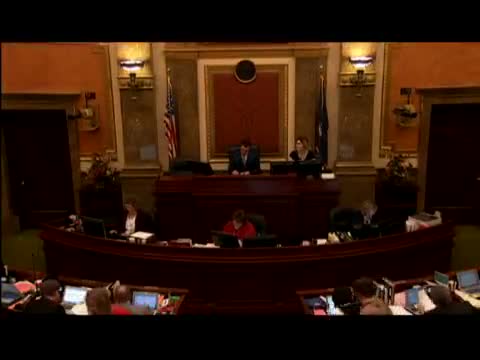
The House suspended constitutional reading requirements to consider the bill the same night and approved the second substitute by voice and roll call; the floor record shows the bill passed the chamber 73‑0 and will be transmitted to the Senate for consideration.
Next steps: The pilot is to run for three years under PEHP oversight. Lawmakers and sponsors said they expect the study to produce usage and cost data that could form the basis of future legislation to extend coverage beyond the state employee plan.