Get Full Government Meeting Transcripts, Videos, & Alerts Forever!
Get email alerts on the Drug Policy topic
No spam. Unsubscribe anytime.
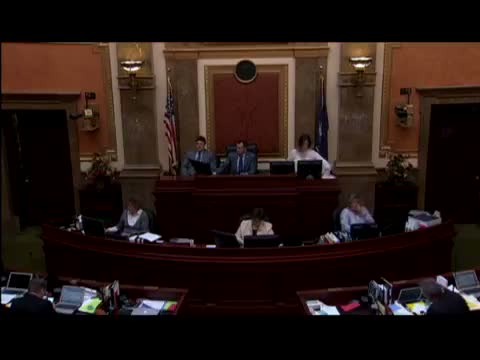
House advances homeless resource-center zone bill after heated debate over felony enhancement
Summary
House passed first substitute to HB 365, narrowing an earlier draft to target drug distribution near homeless resource centers. Floor debate focused on whether raising distribution to a first-degree felony in these zones is appropriate given jail bed capacity and whether it would criminalize addiction; the bill passed 42-30 and will go to the Senate.
Representative Briscoe introduced first substitute House Bill 365 to add homeless resource centers to locations where distribution of controlled substances can receive an enhanced penalty. Briscoe described the narrow scope of his amendment: it limits enhanced penalties to one subsection of unlawful acts (distribution) under Utah Code § 58-37a-5 and does not criminalize possession or paraphernalia alone.
Briscoe told members that Salt Lake City, Midvale City and law enforcement officials supported the amendment, and that prosecutors advised focusing enforcement on organized sellers rather than addicted users. “People who are addicted or are in recovery and struggling don't want to go to the road home,” Briscoe said, stressing the amendment aimed at distributors rather than those seeking treatment.
Opponents questioned whether increasing the penalty to a first-degree felony near homeless resource centers would be enforced as written and warned of limited jail and treatment bed capacity. Representative Ray asked whether Salt Lake County could actually incarcerate first-degree felony offenders when jail beds are constrained and said local law enforcement was already reporting capacity limits. Representative Roberts and others expressed concern that a first-degree enhancement (five years to life) may be too severe for some offenders and underscored the need for treatment and housing solutions alongside enforcement.
Supporters replied that the measure is one piece in a broader strategy and that prosecutors typically target higher-level distributors. Representative Briscoe told the House he had consulted prosecutors who said street-level sellers often plead to lesser charges and are moved out of state, which can hamper local enforcement.
After extended debate on law-enforcement reach, treatment availability and policy tradeoffs, the House voted and the first substitute to HB 365 passed 42-30; the measure will be transmitted to the Senate.