Get Full Government Meeting Transcripts, Videos, & Alerts Forever!
Get email alerts on the Transportation topic
No spam. Unsubscribe anytime.
House rejects EV tax-credit measure after floor debate
Summary
After extended floor debate over costs and air-quality benefits, the Utah House voted to refer HB29 (Energy Efficient Vehicle Amendments) to staff for filing after a roll call the Speaker announced as 'having received 37 votes and 38 votes.' Supporters cited historic registration gains; opponents cited fiscal and emissions concerns.
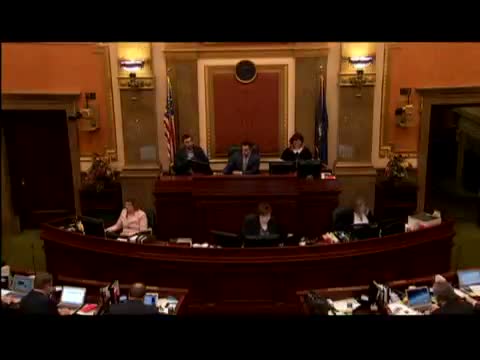
The Utah House debated House Bill 29, the Energy Efficient Vehicle Amendments, on Feb. 28 before voting to refer the bill to staff after the Speaker announced a tally described in the record as "having received 37 votes and 38 votes" and that the measure failed to pass.
Sponsor Representative Handy framed the bill as a measured, time-limited tax-credit designed to accelerate market transformation for zero-emission vehicles in areas of PM2.5 nonattainment. "At the end of 2014, there were 1,118 EVs registered in Utah ... At the end of 2015, there were 1,597," Handy said, arguing the earlier tax credit had "primed the pump." He said the bill focuses incentives on counties out of compliance with air-quality standards and described it as "a small bite from the budget" that could be measured annually.
Opponents raised budget and effectiveness questions. Representative Schultz cited the bill's fiscal note and warned it could cost "roughly basically 4 to 500000 dollars per year" and that those funds might come from the Education Fund. Representative Sandel argued the measure was not the most economical path to cleaner air for his district, asserting that many EVs would be charged from a largely coal-dependent grid: "Those vehicles are gonna be recharged by 70% coal," he said. Representative Hawkes cautioned that correlation does not prove the credit caused purchases and urged more substantive air-quality measures.
Several legislators described personal experience with EVs. Representative Pitcher disclosed he had used a prior credit and said of his car, "I haven't been to a gas station in 2 years," urging colleagues to back the bill as a start toward emissions reductions. The sponsor closed by acknowledging related policy gaps — for example, EVs do not pay gas tax — and said those issues should be addressed in other legislation.
The Speaker ordered a call of the House during the tally; after votes were recorded the clerk announced the substitute HB29 had failed and would be referred to staff. The House did not adopt the proposed tax-credit amendments on the floor that evening.
Next steps: the bill record in the House was referred to staff for filing; sponsors and opponents indicated related policy questions (such as road-funding impacts and measurement of air-quality benefits) could return in future proposals.