Get Full Government Meeting Transcripts, Videos, & Alerts Forever!
Get email alerts on the Elections Nomination Process topic
No spam. Unsubscribe anytime.
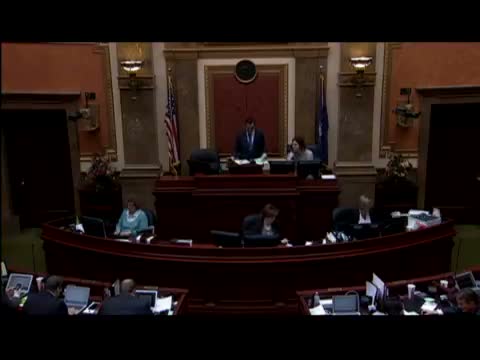
House circles nomination-petition bill after debate over paid signature gatherers and verification deadlines
Summary
Lawmakers debated substitute House Bill 22, which tightens signature-gatherer identification and prohibits per-signature pay while allowing lump-sum or hourly payments; opponents cited U.S. Supreme Court precedents protecting paid circulators. After extended Q&A and concerns about constitutionality and county workload, the House moved to 'circle' the bill for further work.
Representative Green presented substitute House Bill 22 on Feb. 16, a package of nomination‑petition reforms that seeks to require circulator identification and honesty disclosures, permit signers to request removal of their name prior to a February 20 certification date, and prohibit per‑signature compensation while allowing other payment forms (lump sum, hourly) to survive constitutional scrutiny.
Sponsor explanation: Representative Green said the bill grew from concerns about misleading signature-gathering and sought to balance integrity and constitutionality. “We just must be paid by the project or by the day or by the hour or some other means, just not by the signature,” Green said while explaining the substitute’s approach to compensation and the Feb. 20 certification deadline. He described identification requirements that could be a hat, shirt, button, or a plainly visible paper at the time of signature submission.
Constitutional concerns and operational questions dominated floor exchanges. Several members cited U.S. Supreme Court precedent that treating paid petition circulation as political speech protects the practice from certain restrictions; Representative 23 warned that prohibiting payment for circulators “restricts political expression” and could be unconstitutional. Other members raised administrative concerns about the February 20 certification deadline, the feasibility of county clerks’ verification workload, and whether the lump‑sum or hourly payment alternatives actually remove incentives to produce invalid signatures.
Representatives suggested fixes — clarifying that county clerks may begin validation when petitions arrive and that Feb. 20 is the certification deadline rather than a restriction on counting — but voiced divergent views on whether the substitute sufficiently addresses the constitutional problems. Because multiple members asked for additional clarifications and revisions, the House motioned to circle (hold) the bill so sponsors and staff could address outstanding issues.
Outcome: The House voted to circle substitute House Bill 22 to resolve concerns, leaving substantive revision and eventual reintroduction to committee or floor action.
Next steps: Sponsor and staff to consider clarifying language on payment structures, identification visibility, and certification procedures before returning the bill to committee or the floor.