Get Full Government Meeting Transcripts, Videos, & Alerts Forever!
Get email alerts on the Federalism topic
No spam. Unsubscribe anytime.
Rob Bishop urges stronger state role in federal rulemaking; Utah House backs resolution to create a states'check
Summary
Former U.S. Rep. Rob Bishop told the Utah House on Feb. 10 that "federalism" is the remedy to overreaching regulation; the House passed a concurrent resolution, HCR 6, supporting a constitutional amendment to let two-thirds of state legislatures override certain federal administrative actions, 68-11.
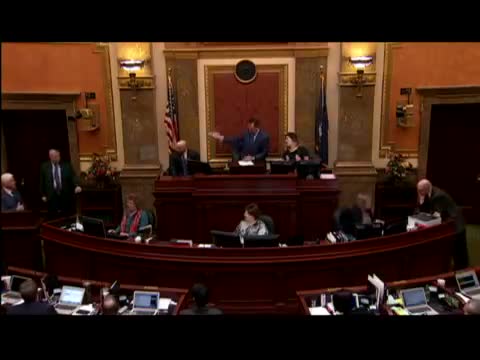
SALT LAKE CITY — Former state House Speaker and U.S. Rep. Rob Bishop told the Utah House on Feb. 10 that the solution to regulatory overreach is to restore state authority and ‘‘federalism,’’ urging a constitutional mechanism to let the states formally check federal administrative actions.
Bishop, speaking after the House resolved itself into a Committee of the Whole to hear him, criticized several last-minute federal regulations and described a proposal he supports to give state legislatures an avenue to force reconsideration of executive orders or agency rules. "The solution to our problems in this nation is the concept of federalism," Bishop said, arguing that clearer coordination rules and statutory changes would protect state and local input on land use, education and other policies.
Representative Dan McLean (note: transcript name for example purposes — see speaker list) and others framed the House debate that followed around a first substitute to House Concurrent Resolution 6 (HCR 6), which expresses Utah's support for a congressional constitutional amendment that would allow two-thirds of state legislatures to adopt resolutions overriding a provision of federal law, an executive order or an administrative rule. Representative Nelson, who sponsored the resolution on the House floor, said the mechanism would be used "only in the most egregious situations" and would prompt federal reconsideration and dialogue.
Not all members agreed. Representative Ivory said he "applaud[ed] the resolution as far as it goes" but warned that similar proposals can exempt Congress itself. Representative Briscoe, invoking historical examples, cautioned about unintended consequences if major civil-rights advances could be reversed through interstate nullification.
The House voted to pass the first substitute to HCR 6, 68-11; the resolution was transmitted to the Senate for further consideration. Bishop also addressed land-management issues during his appearance, urging statutory co-management and specific protections for local practices in areas such as Bears Ears, and said that only statutory language can guarantee certain uses he said local Native Americans requested.
Next steps: the House sent the first substitute HCR 6 to the Senate. No formal amendment to federal law or new statutory authority results from the House'passed concurrent resolution itself; it is an expression of legislative support and a request to Congress to pursue a constitutional amendment.