Get Full Government Meeting Transcripts, Videos, & Alerts Forever!
Get email alerts on the House Floor Roundup topic
No spam. Unsubscribe anytime.
Utah House advances Senate base budgets, approves custody and construction code changes and passes opioid-insurance reporting bill
Summary
On Day 16 the Utah House approved multiple Senate base budgets and passed bills including HB 150 (custody amendments), first substitute HB 37 (construction code amendments) and second substitute HB 90 (insurance/opiate reporting); HB 92 (school restraint) was circled for further work.
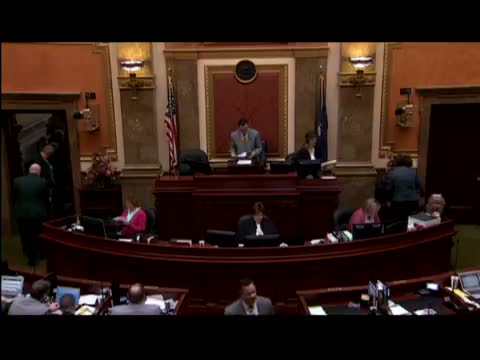
SALT LAKE CITY — The Utah House convened on Feb. 6, 2017, and on a packed morning calendar approved several Senate base budget bills, passed custody and construction-code changes and approved a revised measure addressing insurers' reporting on opioid-related policies.
House members approved first substitute Senate Bill 1 (public education base budget), first substitute SB 5 (natural resources, agriculture and environmental quality), first substitute SB 6 (executive offices and criminal justice) and first substitute SB 7 (social services) and returned them to the Senate for signature. Representative McKay summarized SB 1 as setting base budgets for the minimum school program and related education agencies and said, "the WPU value is the same levels appropriated in fiscal year 2017," noting the FY2017 WPU was $3,184. SB 1 passed the House 75–0; SB 5 passed 73–0; SB 6 passed 73–0; and SB 7 passed 74–0.
Why it matters: those base budgets establish the starting point for appropriation levels the Legislature will refine during the supplemental and general budget process this session.
On policy bills, the House passed House Bill 150, custody amendments related to parents with disabilities. Sponsor Representative Arendt told colleagues the bill requires courts to make specific findings if they infer that a parent's disability limits their parenting, saying the measure "properly places the burden on the parent who wants to assert the disability should limit the other parent's rights." HB 150 passed the House and will be transmitted to the Senate (74–0 recorded).
The House also approved first substitute HB 37, a package of state construction code amendments. Representative Schultz described changes to when a drainage system is required after a geotechnical report, clarified differences between arc-fault and GFI protectors and required compliance for radon mitigation systems; he warned that after July 1, 2018 certain older water heaters could no longer be purchased. The bill passed 73–0.
Opioid-related measure: Representative Ward led action on a second substitute to HB 90, which addresses insurer practices related to opioid prescriptions. Ward said the substituted language removes a strict mandate that insurers adopt specific policies and instead requires insurers to report back to the Legislature on whether they have implemented evidence-based practices. "Instead of requiring a policy change, it says they may institute a policy change," Ward said; he added that reporting requirements would help move practices forward. The House approved the second substitute HB 90, 73–1.
Education restraint bill circled: Debate over HB 92, which would constrain and define the use of physical restraint in schools and require least-restrictive interventions and crisis-de-escalation training, produced substantive concerns on liability and rural response times. Sponsor Representative Moss explained that the bill clarifies definitions and exempts school-district police officers; she offered an amendment to address law-enforcement roles. Representative Moss included the statutory definition in debate: "physical restraint means a personal restriction that immobilizes or significantly reduces the ability of a student to move his or her arms, legs, body, or head freely." After questions and objections about limiting educator options and potential liability, the House voted to circle HB 92 for further work rather than advance it today.
Other action and procedural notes: The House passed HB 60 (deaf and hard of hearing amendments) to standardize terminology in statute; final-passage tally was not specified on the floor. Representative Eliason presented HB 96 (petroleum vapor recovery amendments) as a public-safety and clean-air bill; the transcript records 22 no votes against passage though the yes count was not specified. The Rules Committee assigned multiple bills to standing committees as announced, and the House recessed for caucus lunches.
What members said: Representative Noel, speaking in support of HB 90, recounted a personal loss to underscore the issue: "This young man was 28 years old," he said of a constituent who died of an overdose. Representative Christiansen emphasized the scope of the opioid crisis in Utah and praised the collaborative approach that helped reach the substitute language. Representative Hutchings described the scope of agencies covered by SB 6 and noted the roughly $902 million base budget contained in that bill.
What’s next: Bills that passed and were returned to the Senate await the Senate president's signature or further Senate action; circled bills such as HB 92 will return for additional amendment and committee work. The House recessed for caucus lunches and will resume its calendar later in the day.
Votes at a glance: - First substitute SB 1 (public education base budget): passed House 75–0. - First substitute SB 5 (natural resources, agriculture and environmental quality): passed House 73–0. - First substitute SB 6 (executive offices & criminal justice base budget): passed House 73–0. - First substitute SB 7 (social services base budget): passed House 74–0. - HB 60 (deaf and hard of hearing amendments): final passage (tally not specified on record). - HB 150 (custody amendments related to parents with disabilities): passed 74–0. - First substitute HB 37 (state construction code amendments): passed 73–0. - Second substitute HB 90 (insurance/opiate reporting): passed 73–1. - HB 96 (petroleum vapor recovery amendments): passed; transcript records 22 no votes (yes count not specified). - HB 92 (physical restraint in schools): circled for further work (no final vote).
Sources: Floor proceedings, Utah House, Day 16 (transcript excerpts).