Get Full Government Meeting Transcripts, Videos, & Alerts Forever!
Get email alerts on the Waste Management topic
No spam. Unsubscribe anytime.
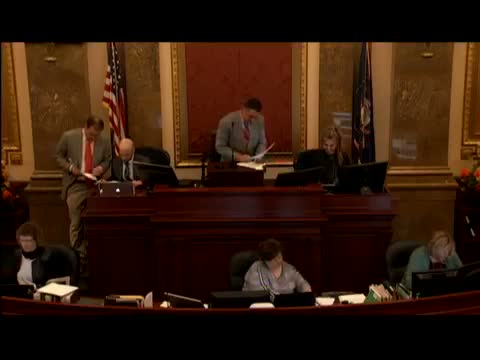
House approves waste-management bill that permits self-inspection and redirects fees after heated debate
Summary
The House passed first substitute House Bill 373 on March 5, 2018, a package of waste-management changes that allows trained self-inspection by facilities, clarifies fee and nonlapsing credit rules, and proposes redirecting the first $400,000 of certain fees; the bill passed 63–8 amid debate over equitable fee language and DEQ capacity.
Representative Perry, sponsor of first substitute House Bill 373, said the bill grew out of a budget deep dive into waste management and is intended to modernize inspection practices, expand online permitting and move the program into the 21st century. He told members that GRAMA requests showed some facilities “hadn't been inspected at all in the last 6 years,” and proposed a self-inspection option paired with training and an ability for the department to revoke self-inspection privileges for serious violations.
Perry also described a proposed reallocation of fees: under current law the first $400,000 of certain landfill fees goes to the general fund; his amendment would use that money to upgrade department technology (about $200,000) and to transfer $200,000 to the Hazardous Substance Mitigation Fund. "One of the things I found out... that the first 400,000 dollars goes back into the general fund. My goal would be... to take that $400,000 this year, bring it back into the department to be used for what it's supposed to be used for," Perry said.
Amendment proponents and opponents debated the bill's fairness language. Representative Miguel and others moved to strike language that read “though not necessarily equal or uniform,” arguing the Legislature intended fees to be fair and equitable statewide. Supporters of leaving the language said the change gives the Department of Environmental Quality discretion to address facility-specific circumstances and that the bill responds to concerns raised in multiple public meetings.
Other members urged caution about self-inspection and funding. Some said the department should instead be adequately funded to conduct inspections directly, while others noted that similar self-inspection programs exist in other regulated areas and can produce better compliance when paired with accountability and the option for the department to step in.
After debate, the House voted; the clerk reported 63 yes votes and 8 no votes. The bill passed and will be transmitted to the Senate for consideration.
What’s next: The bill proceeds to the Senate; sponsors said implementation will include training and an enforcement mechanism allowing the department to remove self-inspection authority for facilities shown to have severe violations.