Get Full Government Meeting Transcripts, Videos, & Alerts Forever!
Get email alerts on the State Budget topic
No spam. Unsubscribe anytime.
Utah House approves package of Senate base budgets, schedules opioid resolution and backs Olympic exploratory committee
Summary
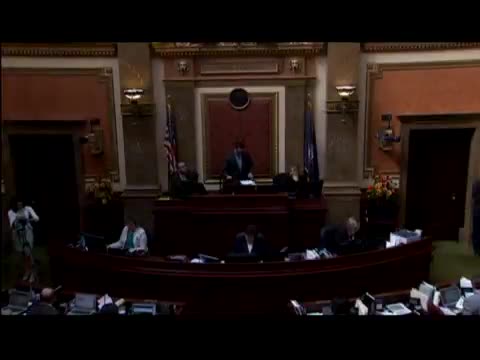
On Feb. 6, 2018, the Utah House approved several first‑substitute Senate base budget bills, concurred with Senate amendments to HB 23, set a time certain for an opioid-related concurrent resolution and passed a resolution supporting an Olympic exploratory committee.
SALT LAKE CITY — The Utah House on Feb. 6 moved forward a set of Senate base budget bills and other measures, voting to approve higher-education, economic-development, infrastructure and veterans budgets while scheduling further floor consideration of an opioid-related resolution.
Lawmakers acted under suspension of the rules to advance and approve multiple first‑substitute Senate budget bills. Representative Grover, the House sponsor for the higher-education base budget, described first substitute Senate Bill 1 as the annual higher education allocation: "For information purposes, this bill will appropriate $1,800,000,000 and change," he said, and noted the funding would come from a mix of the general fund, the education fund and dedicated credits (generally tuition). The clerk reported Senate Bill 1 received 68 yes votes when voting closed under suspension of the rules.
Representative Webb outlined first substitute Senate Bill 4, the Business, Economic Development and Labor base budget. Webb said the bill includes program reductions of nearly $4 million, a $3 million ongoing appropriation for a tourism marketing performance fund, and specific FY2018 and FY2019 line items. The House approved SB 4 under suspension with a recorded vote of 70 yes and 1 no.
Members also considered first substitute Senate Bill 6, the Infrastructure and General Government base budget. Representative Frower said the bill "appropriates $2,300,000,000 FY 2019" and includes funds for administrative services, technology, transportation, capital projects at several universities and adjustments to debt service. The bill was read for second and third consideration as part of the day's calendar business.
The chamber uncircled first substitute Senate Bill 5 (retirement and independent entities base budget) so the full House could consider it. Representative Christiansen summarized subcommittee work and line-item adjustments, saying the subcommittee reviewed roughly $73.3 million in appropriations for FY2018 and about $64.2 million for FY2019 and recommended several base budget changes. Voting under suspension, the clerk reported the bill passed with no recorded 'no' votes and will be returned to the Senate.
Representative Last presented first substitute Senate Bill 7, covering the National Guard, Veterans Affairs and legislative appropriations; the clerk reported SB 7 passed with 72 yes votes.
On a separate motion, the House concurred with Senate amendments to House Bill 23 (Office of Economic Development amendments). The motion to concur passed and the clerk recorded 71 yes votes, 0 no votes; HB 23 will be returned to the Senate.
The chamber also took up nonbudget business. Representative (17) moved to schedule a concurrent resolution on deaths from opioid-induced postoperative respiratory depression (SCR 4) for consideration at a time certain — Wednesday, Feb. 7 at 2:30 p.m. — which the House approved. Later in the morning the House lifted Senate Concurrent Resolution 9, supporting Utah's Olympic exploratory committee, to the top of the Senate third-reading calendar. The body debated the measure in supportive terms and approved SCR 9; the resolution was signed by the Speaker Pro Tem and will be returned to the Senate.
Clerks and committee chairs provided additional committee reports and committee-assignment recommendations. The Rules Committee reported assignments for dozens of recently introduced House bills and the House adopted the committee-assignment motion.
The House recessed for caucus and scheduled events after completing the morning's business. Several non-substantive recognitions — including Southern Utah University Day and visits by the Utah Developmental Disabilities Council and students from Saint Joseph Catholic School — were read into the record earlier in the session.
What happens next: Bills approved under suspension are returned to the Senate for signature; the scheduled time-certain for SCR 4 means the chamber will revisit the opioid resolution on Feb. 7 at 2:30 p.m. for further floor action.