Get Full Government Meeting Transcripts, Videos, & Alerts Forever!
Get email alerts on the Legislative Proceedings topic
No spam. Unsubscribe anytime.
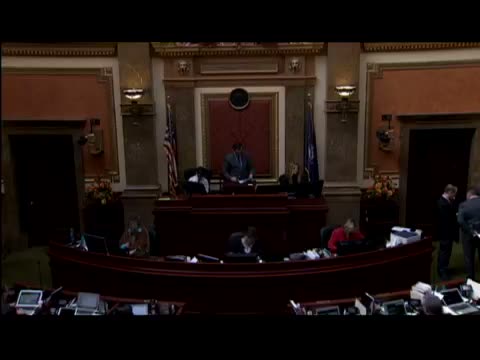
Utah House passes mental-health, ombudsman and retirement bills; recorded votes send multiple measures to the Senate
Summary
The Utah House on Feb. 7, 2018, advanced a package of bills including extensive amendments to the Substance Abuse and Mental Health Act, changes to long-term care ombudsman duties, and clarifications to retirement forfeiture notification procedures; several measures passed by recorded votes and will be transmitted to the Senate.
The Utah House of Representatives on Feb. 7, 2018, passed several bills on third reading and moved additional measures forward, voting to transmit them to the Senate for consideration.
The most substantive debate centered on House Bill 99, "Substance Abuse and Mental Health Act Amendments," which the sponsor described in a section-by-section presentation that spanned peer-support certification, involuntary-commitment procedures, and hospital and law-enforcement protocols. The sponsor said the bill establishes certification and supervision standards for peer support specialists (including both substance-use and mental-health peer specialists), defines "community mental health center" and "mental health officer" with reference to clinical codes (DSM-5/ICD-10), clarifies involuntary commitment processes and court hearings, and permits a provider to hold a voluntarily admitted patient an additional 48 hours in specified circumstances. The bill also adds language to govern secure areas in behavioral health units and directs certain procedures for law enforcement encounters with unstable individuals in the community. After debate, the clerk recorded 68 yes votes, 0 no votes; the bill passed the House and will be transmitted to the Senate.
Representative Doth presented House Bill 137, which removes the term "elderly" from the statewide ombudsman's statutory duties so the office can provide oversight and advocacy for adults with disabilities in assisted-living settings who are not elderly by age. The sponsor said the change is narrow, intended to close a coverage gap, and carries no additional fiscal impact. HB 137 received a recorded vote of 68 yes, 0 no and passed the House for transmission to the Senate.
The House also considered retirement-related bills. First substitute House Bill 147, addressing retirement forfeiture for employment-related offenses, clarifies which offices may notify the Utah Retirement System and participate in related investigations (for example, a district attorney, county attorney, the attorney general's office, or the state auditor). Members questioned whether notification of a charge would trigger forfeiture; the sponsor emphasized that the notification requirement in code does not in itself forfeit retirement benefits and that forfeiture occurs only after a conviction. The first substitute HB 147 passed the House by recorded vote (66 yes, 0 no) and will be transmitted to the Senate.
Other measures handled by the House included committee reports placing a number of bills on the consent calendar and the introduction or first reading of a large set of bills across policy areas (taxation, transportation, public utilities, natural resources, judiciary, and more). The clerk and committee chairs reported items passed by the Senate and listed bills assigned to standing committees by the Rules Committee.
Votes at a glance House Bill 137 (Long-Term Care Ombudsman Amendments): 68 yes, 0 no; passed and transmitted to Senate. House Bill 99 (Substance Abuse and Mental Health Act Amendments): 68 yes, 0 no; passed and transmitted to Senate. First Substitute House Bill 147 (Retirement forfeiture for employment-related offenses): 66 yes, 0 no; passed and transmitted to Senate. (Other bills were introduced, circled for later consideration, or placed on calendars as recorded by the clerk and committee chairs.)
What happens next Passed House measures will go to the Senate for consideration and any floor action there. Several items were also circled or set for second-substitute work and will return to the House for further action. The House recessed for caucus lunch and planned to reconvene at 2:00 p.m.
Quotes from the record "House bill 137 does 1 thing very simply. It removes the term elderly from what the statewide ombudsman is supposed to take care of right now," Representative Doth said while explaining HB 137.
On HB 147 and concerns about timing of notification, one member asked for reassurance that forfeiture would follow a conviction rather than a mere charge; the sponsor replied that "notification doesn't trigger... forfeiture of the retirement benefits" and that forfeiture "only occurs after a conviction."