Get Full Government Meeting Transcripts, Videos, & Alerts Forever!
Get email alerts on the Health Insurance Right To Shop topic
No spam. Unsubscribe anytime.
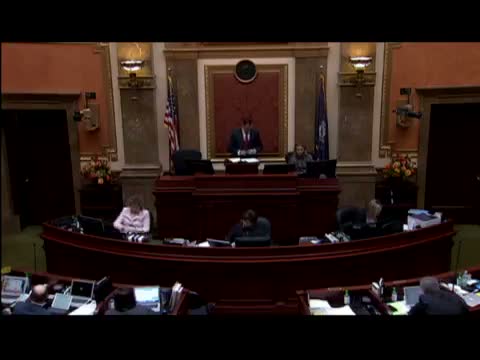
Utah House debates 'right to shop' health-insurance bill as members press for consumer protections
Summary
Lawmakers debated House Bill 19, which would authorize PEHP and other plans to offer a "savings reward" that shares plan-level savings with consumers who choose lower-cost covered care; members questioned quality safeguards, out-of-network risk, and transparency. A motion to circle failed and further action proceeded on the floor.
Representative Thurston, sponsor of House Bill 19, told the House the bill would legally permit public and private plans to give consumers a share of plan-level savings when they choose lower-cost, covered health care. "This bill is designed squarely to motivate patients in a certain segment of their care to engage," Thurston said, framing the measure as a way to lower long-term costs for the Public Employees Health Program (PEHP) and for taxpayers.
Thurston and supporters cited pilot programs in other states. He said Maine and New Hampshire reported significant savings where similar programs were used and asked the House to allow PEHP to design a flexible program rather than impose detailed mandates. "If PEHP launches this, and nobody does it, PEHP never writes a check," Thurston said, arguing the bill carries little downside and potential fiscal benefit.
Opponents and questioners pressed several practical concerns. Representative Wheatley asked what types of services would be "shoppable," and Thurston replied that the program targets benefits where consumers can compare options in advance (for example, outpatient procedures and some pharmacy purchases), while emergency or single-provider services would not be appropriate. Members repeatedly raised the possibility that lower cost does not always equal adequate quality. Representative Dunnegan asked who would pay for care if a lower-cost provider caused a complication; the sponsor replied such outcomes depend on plan contracts and that PEHP sets network and swing-benefit rules.
Lawmakers also debated transparency and network rules. Several representatives said that price transparency would be essential for consumers to shop intelligently; others noted that PEHP already publishes contracted amounts online and that the program can be designed to encourage in-network, vetted providers. Questions about preauthorization, out-of-network coverage, and whether consumers could privately negotiate cash prices were left to plan design rather than spelled out in statute.
The House debated a motion to circle (set aside) the bill to continue work; that motion failed in division with 34 yes votes and 39 no votes. After further debate, the sponsor urged passage to let PEHP pilot a program and to allow private insurers to follow suit. At the close of the transcript the House had opened voting on HB 19; the final disposition (passage or defeat) was not recorded in the provided floor transcript.
What it would do: HB 19 would make explicit that PEHP and other insurers may create "savings reward" programs that share some plan-level savings with insured consumers who select lower-cost covered care. It does not compel commercial insurers to adopt programs and leaves program design (eligibility, in-network vs. out-of-network treatment, quality metrics, and sharing formulas) to the plans.
Next steps: Voting was opened on the floor after prolonged debate; the transcript ends before a final roll-call result for HB 19 was recorded.