Get Full Government Meeting Transcripts, Videos, & Alerts Forever!
Get email alerts on the Local Government Registries topic
No spam. Unsubscribe anytime.
Senate advances bill limiting municipal relationship registries, citing protection for Amendment 3
Summary
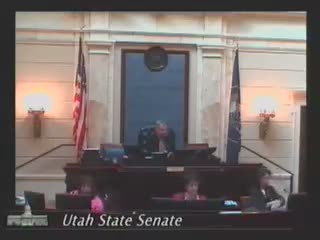
Senate sponsors moved first substitute SB 299 to the top of the second‑reading calendar after a lengthy debate over whether municipal ‘registries’ could be treated as substitutes for marriage; sponsors said the bill preserves city discretion to offer limited benefits while barring registries that ‘give legal status or effect’ equivalent to marriage.
Senators moved first substitute Senate Bill 299 to the top of the second‑reading calendar after an extended floor debate about the scope of municipal registries and the status of marriage under state law.
Senator Bell, the bill’s sponsor, told the Senate the measure is narrowly drafted to allow municipalities to “make benefits generally available to all municipal employees” and to create registries for “adult relationships of financial dependence or interdependence.” He said the critical prohibitions are limited: “a municipality may not create or maintain a registry or other means that defines, identifies or recognizes and gives legal status or effect to a domestic partnership, civil union, or domestic cohabitation relationship other than marriage.” Bell said the purpose is to “vindicate Amendment 3 and the Defense of Marriage Act passed in the state of Utah” while still allowing cities to provide certain administrative benefits.
Senator Davis, who offered Amendment No. 3, characterized the debate as linguistic and practical: “This is a bill that I really believe is a bill of semantics,” he said, explaining his amendment aimed to clarify hospital‑visitation and end‑of‑life access for designees registered under a municipal registry. The amendment was offered for consideration and subsequently adopted after division and roll‑call procedures.
Other senators pressed the sponsor on legal risks and the practical effect of the bill. Senator McCoy and others questioned whether municipal ordinances could be used in a later court proceeding to argue that a state constitutional amendment had been undermined; Bell and supporters said their goal was to place marriage in a preeminent position while permitting narrowly tailored municipal practices that meet legitimate needs such as bereavement or benefit administration.
Action on the bill was procedural in this session: the Senate moved SB 299 to the top of the second‑reading calendar and circled it for later floor action rather than taking final passage on the day’s floor. Sponsors framed the bill as allowing registries that do not purport to create a surrogate for marriage while barring registries that grant legal status equivalent to marriage. The bill’s text, as discussed on the floor, leaves specific implementation and remaining legal questions to future ordinance language and, potentially, judicial review.
What’s next: SB 299 was placed on the second‑reading calendar and circled for subsequent consideration. Further amendments or judicial developments could affect how the statutory language is applied by municipalities.