Get Full Government Meeting Transcripts, Videos, & Alerts Forever!
Get email alerts on the Legislation Roundup topic
No spam. Unsubscribe anytime.
Senate advances broad slate of bills including net metering, education and labor measures
Summary
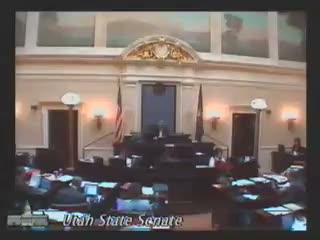
On Feb. 19 the Utah Senate moved a large third- and second-reading calendar, passing a range of bills on topics from net metering and classroom displays to worker-classification and anti-discrimination protections; several bills passed with little floor debate while others generated question-and-answer exchanges.
The Utah Senate on Feb. 19 cleared a long slate of bills, moving many items to the House for further action and approving numerous measures on the third-reading calendar.
Senator Dayton described Senate Bill 162 as establishing financial limits and approval requirements for the state's commitments in federal education agreements, and the bill passed on roll call. "Senate Bill 162 is the bill that puts into place some financial limits to which the state will be committed," Dayton said; the clerk recorded the bill as passing the chamber.
Energy policy advanced with first substitute Senate Bill 84, which raises commercial net-metering generation to 2 megawatts and was presented by Senator Van Tassel, who cited likely early deployment at venues such as the Salt Palace. "This is monumental in the state of Utah where it increases the generation to 2 megawatts for commercial entities," the sponsor said; the bill passed and will be referred to the House.
Labor and employment bills also moved forward. Senator Eastman presented SB189, an independent-contractor database requiring interagency sharing to detect intentional misclassification of workers, and Senator McCoy introduced SB166 to add "military service" to protected characteristics in discrimination law; both passed on voice or roll-call votes and were referred to the House.
Other action included final passage of bills addressing calls of action for defective construction (SB220), reauthorization of administrative rules (SB43), and child-protection language in SB183 (which added a mens rea element). Several House bills were also considered or amended on second reading and advanced toward third reading, including campaign-report amendments (HB41), alternative-fuel access (HB103), and higher-education business-resource funding (HB37).
Where the floor debated specifics, senators asked questions about fiscal notes, appeals processes and administrative implementation. For example, senators pressed on the amended-statement fee language in campaign-report changes, asking whether calculation errors would trigger the mandatory fee; the sponsor said the bill was aimed at substantive amendments while routine calculation corrections would be handled through existing amendment or correction processes.
Votes at a glance (selected): SB162 (education agreements) — passed; First Sub. SB89 (invasive species mitigation) — passed (24 yes, 2 no, 3 absent); First Sub. SB84 (net metering) — passed; SB190 (classroom display) — passed (26 yes); SB183 (child pornography amendment) — passed (27 yes); First Sub. SB166 (non-discrimination — military service) — passed (27 yes); SB189 (independent-contractor database) — passed (26 yes); SB220 (defective construction claims) — passed (27 yes); SB43 (rules reauthorization) — passed (26 yes).
The Senate recessed until 2 p.m. after completing the morning calendar and preparing several passed bills for enrollment and transmittal to the House and, where applicable, the governor.