Get Full Government Meeting Transcripts, Videos, & Alerts Forever!
Get email alerts on the Open Data Finance topic
No spam. Unsubscribe anytime.
Senate advances bill to build a state transparency website with $480,000 startup cost
Summary
Senate Bill 38, a transparency-in-government-finance bill to create a single searchable state financial website and a transparency board, advanced from second substitute to third-reading status. Sponsor cited examples in other states and a fiscal note: $480,000 one-time, $250,000 ongoing.
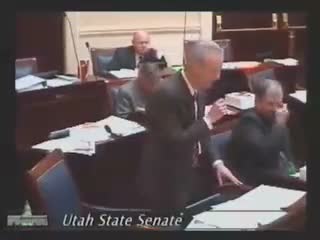
Senate Bill 38’s second substitute, which would create a centralized state website to present government financial information and establish a transparency board, was explained on the Senate floor and advanced on Feb. 14.
Senator Niederhauser described the proposal as a ‘‘single point’’ for citizens to view government finances — a state portal modeled on initiatives in other states. He said the first-year plan focuses on state agencies and that the transparency board (composed of legislators and executive-branch members) would decide, over the following years, how far to apply the standard to local entities such as school districts, cities and special districts. The sponsor noted opposition from counties to the first substitute but said the League of Cities and Towns supports the second substitute.
Niederhauser cited a fiscal note of $480,000 one-time and $250,000 ongoing. He argued the site could produce savings by exposing redundancies and procurement inefficiencies and pointed to other states that used executive action or private-sector help to stand up similar websites, noting potential security safeguards to prevent release of private data. Senator Jenkins asked whether the board’s work would require small cities to adopt costly systems; Niederhauser said the board could recommend low-cost approaches (for example, posting PDFs or leveraging private offers) and that the initial requirement affects state agencies only.
After questions and discussion about scope and small-town costs, the Senate called the question. Second substitute SB38 received 26 yes votes, 0 nay votes, with 3 absent and will be read for the third time.
The transcript records no final decision on how the board will phase in local entities; implementation details and technical standards will be set by the board specified in the bill.