Get Full Government Meeting Transcripts, Videos, & Alerts Forever!
Get email alerts on the Capitol Space Scheduling topic
No spam. Unsubscribe anytime.
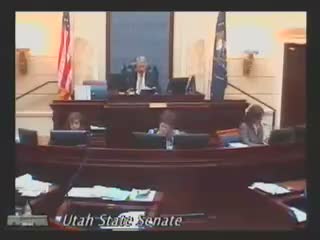
Utah Senate gives itself scheduling control of key Capitol rooms after amendment, approves bill unanimously
Summary
The Senate adopted an amendment to Senate Bill 112 to assign scheduling authority for three secured Senate-area spaces to the Secretary of the Senate and passed the bill 28-0-1 after debate about accommodating the Supreme Court's use of the chambers.
The Utah Senate on Jan. 18, 2008 passed Senate Bill 112, which clarifies that three secured areas in the Capitol — the Supreme Court Chambers, the rules/deliberation room and a shared office — will be under the control of the Senate and that scheduling for those spaces will be assigned to the Secretary of the Senate.
Senator Greg Bramble, sponsor of the bill, offered Amendment 1 to replace references to the Capital Preservation Board with the Secretary of the Senate; the body adopted the amendment by voice vote before proceeding under suspension of the rules. Bramble said the change is intended to "bring consistency" so the same official schedules the three areas.
The bill prompted questions from Senator Hilliard, who said he wanted assurance the measure would not effectively bar the Supreme Court from holding oral arguments in the Capitol during the legislative session. "I can't imagine that even having an argument once during the session could not be done in such a timing thing that they could use that, have access to our rules committee room and use that and end up using the space efficiently," Hilliard said, urging careful drafting so the court can still be accommodated.
Bramble said a memorandum of understanding — which he said had been reviewed by presiding officers and discussed with Chief Justice Durham — anticipates at least one oral argument during the first week of session but "does not preclude others if there is a reasonable and persuasive reason to have it." The presiding officer clarified that the memorandum provides for one in-session argument and places no off-session restriction other than on interim days.
Senators were also reminded that because the measure carries an immediate-effect option, adoption with an immediate effective date would require a two-thirds majority of the Senate; Bramble noted that when explaining the bill's calendar and timing. After floor discussion the Senate advanced the bill under suspension of the rules and approved it by roll-call vote, 28 yes, 0 nay, 1 absent. The bill was referred to the House for further action.
The legislation aims to create a single scheduling point of contact for overlapping uses of ceremonial and secured spaces, while the memorandum of understanding and the bill text were described on the floor as mechanisms to preserve the judiciary's ability to use the facilities under limited, agreed conditions.