Get Full Government Meeting Transcripts, Videos, & Alerts Forever!
Get email alerts on the Session Roundup topic
No spam. Unsubscribe anytime.
Senate advances package of bills on ethics, energy, land swaps and public safety
Summary
On March 11, 2009 the Utah Senate passed a batch of bills including a one-year 'cooling-off' lobbying restriction, an energy-policy amendment requiring impact reviews, and a controversial land-exchange to support a commuter-rail station; several other bills also passed by recorded vote.
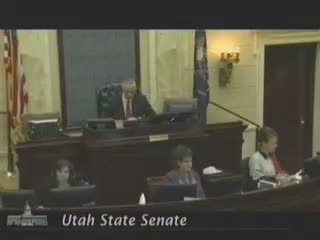
The Utah Senate met for the penultimate day of the 2009 session and cleared a broad set of bills on procedural and policy matters, including ethics rules, energy-policy language, and local infrastructure measures. The chamber approved several bills on third reading after debate and roll-call votes.
Key outcomes at a glance: House Bill 345 (restrictions on elected officials becoming contract lobbyists) passed after floor debate, 16 yea, 13 nay. House Bill 412 (state energy policy amendments) passed following an amendment narrowing its scope, 22 yea, 4 nay, 3 absent. House Bill 179 (state-owned land amendments to enable a commuter-rail site swap) passed 21 yea, 8 nay amid heated floor debate about archaeology and special-interest benefits. House Bill 14 (reducing penalties for certain sexting incidents involving minors) passed 22 yea, 2 nay, 5 absent. House Bill 390 (absentee-ballot timing) passed 18 yea, 9 nay, 2 absent. House Bill 402 (carbon-monoxide detector enforcement language) passed 24 yea, 1 nay, 4 absent. The Senate also concurred with House amendments on several bills (for example, First Substitute SB 147 and SB 161 passed 27-0 with two absences).
Sponsors and supporters framed many of the measures as technical fixes or public-interest reforms. Senator Bell, sponsor of HB 345, urged passage as part of an ethics package: "With that, Mr. President, I would move that House Bill 3 45 pass." Opponents on several bills warned about unintended consequences or burdens (on voters, legislators or agencies) if certain language remained in law.
What happens next: Passed Senate measures will be returned to the House where appropriate signatures will be collected for enrollment; some bills were circled for technical or funding coordination and will return to further consideration. Several items were lifted for the second-reading calendar and the Senate recessed until later in the day to continue work.