Get Full Government Meeting Transcripts, Videos, & Alerts Forever!
Get email alerts on the Session Roundup topic
No spam. Unsubscribe anytime.
Senate passes wide slate of bills at mid‑session; one tax cleanup tabled amid fiscal concerns
Summary
The Utah Senate passed a bundle of House and Senate measures on issues ranging from financial investigations and vehicle immobilization to aviation fuel taxes and property‑tax rules; one tax cleanup bill was later tabled on third reading after fiscal concerns were raised. Vote tallies and formal actions were recorded on multiple measures.
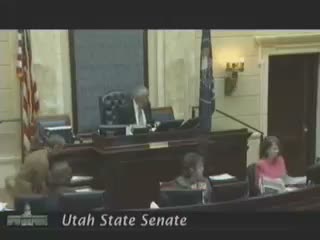
The Utah State Senate handled a large volume of legislation at its mid‑session meeting, approving several bills and forwarding them to the House while tabling at least one item after members raised fiscal concerns.
On third reading, Senate Bill 140, a measure described by sponsor Senator Dayton as aimed at speeding investigative processes to help law enforcement locate and freeze assets for victim protection, passed on a roll call with 26 yeas, 0 nays and 3 absent. Senator Dayton said the bill was brought by the Attorney General’s Office to “speed the investigative process and make it easier for law enforcement to find assets and bank accounts and freeze them to help with victim protection.”
The chamber approved Senate Bill 141 (Aviation Fuel Tax Amendments) and Senate Bill 50, a consumer‑protection measure regulating vehicle immobilization devices. Sponsor Senator Niederhauser said SB141 was discussed the previous day and had no questions on the floor; SB141 passed with 27 yeas, 0 nays and 2 absent. Senator Goodfellow described SB50 as “requiring signage” and capping the boot fee at $75, with the person who placed the boot required to put contact information on the vehicle; SB50 passed 25 yeas, 0 nays and 4 absent.
The first substitute to Senate Bill 135, dealing with local district taxing authorities and service areas governed by unelected boards, was uncircled and carried after sponsors said it would require an elected body to approve tax increases or have the board migrate to an elected format. The measure passed with 23 yeas, 1 nay and 5 absent.
On property‑tax matters, the Senate adopted a second substitute of House Bill 23 to include redemptions in the certified‑rate computation while addressing effective‑date timing to avoid duplicative administrative work. The second substitute passed 28 yeas, 0 nays and 1 absent and was placed on the third‑reading calendar.
House Bill 27, a bill addressing the agricultural right to practice and urban encroachment, was amended (a minor textual change on Line 46) to return the statutory test to its prior form. Senator Valentine said the amendment removed the objections he had to the measure and the bill passed third reading with 22 yeas, 5 nays and 2 absent.
The Senate also moved forward several other House bills (HB53, HB67, HB90, HB21, HB28, HB67 and HB236) and adopted a joint resolution (HJR10) honoring explorers Domínguez and Escalante. Notably, the first substitute to House Bill 90 — which removes a prior requirement that some late‑term procedures be performed in a hospital and clarifies the term “viable,” and that also adds criminal penalties for illegal abortions that result in a death of an unborn child — passed the Senate on a recorded vote (18 ayes, 3 nays reported on the floor) after some members pressed about potential litigation and fiscal exposure for legal defense costs.
A housekeeping concurrent resolution (HCR8) urging the Bureau of Land Management to proceed with Resource Management Plans for energy‑producing areas passed (23 yeas, 4 nays, 2 absent); Senator Romero explained he voted no because he believed the incoming federal administration should review prior plans rather than be urged to rubber‑stamp them.
One measure received particular procedural attention: House Bill 20 (a repeal of certain income tax credits and checkoffs that auto‑sunset) was read for third but then — after Senator Hilliard raised concerns about a fiscal note and the possibility of unaddressed legal costs — the Senate voted to table the measure on third reading pending further fiscal clarification.
Action summary (selected items with floor outcomes): - SB140 — passed (26–0, 3 absent) and sent to the House. - SB141 — passed (27–0, 2 absent) and sent to the House. - SB50 — passed (25–0, 4 absent) and sent to the House. - First substitute SB135 — passed (23–1, 5 absent) and sent to the House. - HB23 (second substitute) — passed (28–0, 1 absent) and placed on third reading. - HB27 — amended and passed on third (22–5, 2 absent); will return to the House. - HCR8 — passed final passage (23–4, 2 absent); signed in open session. - HB90 (first substitute) — passed on roll call for third reading (18–3 reported); sponsor and critics discussed litigation risk. - HB20 — initially passed then tabled on third due to fiscal concerns. - HB236 — amended (changes to administrative charge language and oversight) and placed on third.
The session concluded with committee notices, a Doctor’s Day and health screenings announced for the rotunda, and the Senate recessed until 2 p.m.