Get Full Government Meeting Transcripts, Videos, & Alerts Forever!
Get email alerts on the Legislative Calendar topic
No spam. Unsubscribe anytime.
Utah Senate advances package of bills — art inventory, wildlife limits, gang loitering, mining, ATVs and early voting changes move to third reading
Summary
On day two of the 2009 Utah legislative session the Senate advanced several bills to the third-reading calendar, including a state-owned art inventory (SB 10), wildlife administration limits (SB 13), an anti-gang loitering measure, mining and ATV amendments, and changes to early-voting requirements.
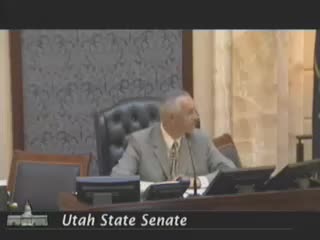
The Utah State Senate on day two of its 2009 session advanced a group of bills to the third-reading calendar and circled others for later action.
Senate Bill 10, sponsored by Senator Mark Madsen, would create a master inventory of state-owned art and add training and oversight to protect artworks housed in courthouses, the state capitol and other public buildings. "This bill attempts to create an inventory and then provides for some additional training and oversight to protect the assets that belong to the state," Madsen said. He estimated the fiscal impact as "around $40,000" the first year and about $24,000 annually thereafter and pledged to provide exact figures by third reading. The Senate voted 28–0 to place SB 10 on the third-reading calendar.
Senate Bill 13, introduced by Senator Dayton and described in the chamber as the "DEER birth control" bill, would reaffirm that wildlife management and the administration of substances to animals remain under the Division of Wildlife Resources and the Department of Natural Resources. Dayton said the bill "does not preclude administration of substance by those who are vets or under control of the state or with them and anybody that's doing a study with wildlife would, of necessity, have to coordinate with the Division of Wildlife Resources." Senators questioned whether the language could unintentionally ban defensive tools such as bear deterrents; Dayton said permitted predator-control activities coordinated with wildlife authorities would not be affected. The bill was advanced for further action (vote tally not specified in the record excerpt).
Law-and-order measures also moved forward. A revised anti-gang loitering bill, described by Senator Greiner as a compromise aimed at addressing constitutional concerns raised last year, would establish a local complaint-and-hearing process for designating "gang-free" zones and require additional officer training. Greiner cited the U.S. Supreme Court's Morales decision as background for how the bill was revised. The Senate recorded the vote on that measure as 26–1 (with 2 absent) when it advanced to the third-reading calendar; Senator Romero said he voted no, expressing remaining constitutional concerns about restrictions on assembly and officer discretion.
On natural-resources policy, Senator Stoll presented Senate Bill 17 to preserve certain reporting and revegetation requirements related to surface coal mining that were set to sunset; he said the changes bring state law into alignment with recent federal changes. That bill passed second reading by voice roll call (25–0 with four absent) and was placed on third reading.
Criminal-justice amendments (Senate Bill 19), which would add enhanced penalties for crimes committed for the benefit of or in association with criminal street gangs, were described as supported by law enforcement and cleared second reading by a recorded vote of 25–0 (4 absent).
Senate Bill 22, an update to the street-legal all-terrain vehicle statute that creates a separate "utility type vehicle" category with size and inspection requirements, passed second reading 27–0 with two absent. Sponsor Senator Jenkins said the changes respond to safety concerns and prevent unintentionally registering oversized "rock crawlers" and highly modified vehicles under the type-2 ATV catchall.
Senate Bill 24, sponsored by Senator Knudson, would remove the statutory obligation in first-class counties to provide an early-voting polling place within each state senate district; Knudson said the change is intended to allow better use of limited election resources while preserving early-voting opportunities. The bill passed second reading 28–0 (1 absent).
Several bills were "circled" (left in place for later consideration) including Senate Bill 12 (DUI amendments) and Senate Bill 18 (Utah Transparency Advisory Board amendments), per chamber procedure.
The Senate concluded the day's business by receiving communications about House-passed bills, welcoming a group of Native American tribal leaders (including Chairman Bruce Perry of the Northwest Band of Shoshone Nation), noting upcoming caucus and evening events, and adjourning until 10 a.m. the next day (with an additional reconvening planned that evening).