Get Full Government Meeting Transcripts, Videos, & Alerts Forever!
Get email alerts on the Floor Roundup topic
No spam. Unsubscribe anytime.
Utah Senate confirms appellate judge, advances broad consent calendar and sends several measures to the House
Summary
On day 31 the Utah Senate confirmed Stephen L. Roth to the Court of Appeals, advanced a lengthy consent and concurrence calendar of technical and policy bills, and approved several measures for transmission to the House. Two high-profile public-safety bills were debated later in the day. (Votes and key outcomes listed.)
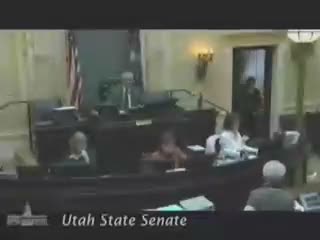
The Utah Senate convened for its 31st day and confirmed Judge Stephen L. Roth to the Utah Court of Appeals, approved a multi-item consent calendar and concurred with House amendments on several bills before recessing for the afternoon.
Judge Roth’s nomination was transmitted to the Senate by letter from the governor and recommended favorably by the Judicial Confirmation Committee. “He has a tremendous understanding of the law,” Scott Jenkins, chair of the Judicial Confirmation Committee, said in reporting the committee’s endorsement. Sen. Hillier moved confirmation; the roll call recorded 24 yeas, 0 nays, and five senators absent, and the Senate declared the confirmation unanimous.
Following the confirmation, the Senate considered and approved multiple bills on the consent calendar, moving measures such as Senate Bill 189 (Capital Facilities Amendment), House Bill 263 (technical cross-reference corrections), House Bill 274 (statutory construction compliance), Senate Bill 123 (Motion Picture Incentive Fund amendment), Senate Bill 181 (Employment Security Administration fund repealers) and House Bill 43 (Unemployment Compensation Amendment). Those measures were forwarded to the House for further action or enrollment.
The Senate also acted on concurrence items. It concurred with House amendments on Senate Bill 12 (individual income tax contribution to a methamphetamine housing fund) and first substitute Senate Bill 41 (drug utilization review board amendment), and approved Senate Bill 85 (construction trade licensing amendments) for transmission back to the House.
Not all floor business was routine. Later in the day the Senate debated and voted on higher-profile items (see separate articles for Senate Bill 113, a proposed restriction on wireless-phone use by minors while driving, and House Bill 201, a proposed restriction on novelty toy lighters). Those measures failed on final passage after extended floor debate.
The body concluded morning business with passage of House Joint Resolution No. 2 (a proposed constitutional amendment to provide a property-tax exemption for certain nonprofit water facilities), and House Bill 97 (amendments related to deceptive consumer practices), then recessed until 2 p.m.
Votes at a glance
- Confirmation: Stephen L. Roth to the Court of Appeals — confirmed, 24–0, 5 absent. - Senate Bill 189 (Capital Facilities Amendment) — passed; recorded unanimous vote of senators present. - House Bill 263 (technical cross-reference revisions) — passed unanimously by recorded vote. - House Bill 274 (statutory construction compliance) — passed, 24–0, 5 absent. - Senate Bill 123 (Motion Picture Incentive Fund amendment) — passed by unanimous voice/recorded procedure. - House Bill 43 (Unemployment Compensation Amendment) — passed; recorded unanimous vote of senators present. - Senate Bill 12 (concurrence and final passage) — concurred and passed on final roll call. - House Joint Resolution No. 2 (property-tax exemption for nonprofit water facilities) — passed, 24–0, 5 absent.
Next steps
The bills that passed in the Senate will be returned to the House as required, and the confirmed judicial appointment will be finalized following the prescribed enrollment process. The Senate recessed for a midday break and is scheduled to reconvene later in the day.