Get Full Government Meeting Transcripts, Videos, & Alerts Forever!
Get email alerts on the Education Funding topic
No spam. Unsubscribe anytime.
Utah Senate approves measure to accept roughly $100 million in federal Education Jobs funds after heated debate
Summary
In a Nov. 10, 2010 special session, the Utah Senate voted to accept federal Education Jobs funds to help school districts cover a midyear shortfall, approving the joint resolutions after debate over federal overreach and multiple amendments failed.
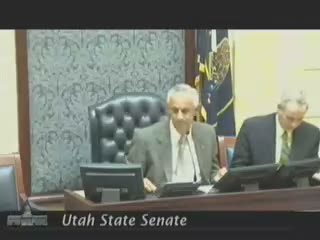
SALT LAKE CITY — The Utah State Senate voted on Nov. 10, 2010 to accept federal Education Jobs funds intended to help local school districts cover a midyear budget shortfall, approving the joint resolutions in a special session after several hours of debate.
Senators approved the measure in two separate but related steps: the Senate considered HJR 201 under suspension and then concurred with House amendments to SJR 201. The motion to read HJR 201 for second and third reading under suspension carried, and a roll-call for final passage recorded 22 yea votes, 6 nay votes and 1 absent. Later concurrence on SJR 201 was recorded as 28 yea votes, 0 nay votes and 1 absent.
The measure responds to federal Education Jobs funding packaged in 2010. Sponsor Senator Hilliard said the resolution authorizes the spending of roughly "101 point something million dollars," and that the funds are intended as one-time money to "help retain existing employees, avoid further layoffs in many school districts and possibly can hire new employees to provide early childhood, elementary and secondary educational related services." He said the state faced approximately a $50,000,000 shortfall in public education for fiscal year 2010 and that the federal funds would help districts avoid midyear cuts.
Opponents framed the vote as a constitutional and governance concern. Senator Butters argued the federal package "totally puts the federal government in charge of the distribution of funds in our state" and urged rejection, describing the legislation as written on "funny money." Senator Stevenson warned of federal encroachment on state authority, saying, "unless the states are willing to rise up and reclaim their authority, Federalism is dead." Supporters pushed back that Congress has spending power and that the one-time funds could blunt immediate harm to students and teachers; Senator Robles noted court and statutory precedent supporting Congressional spending authority.
An amendment offered by Senator Jones to add explicit findings about the benefits of accepting the money (for example, retaining teachers and funding specialist positions) was offered and debated but failed on the floor. Senator Butters later offered a second substitute that would have rejected the federal approach; that substitute failed on a roll call (8 yes, 20 no, 1 absent).
Sponsor Hilliard told colleagues that rejecting the funds would force the Legislature to choose among tapping the Rainy Day Fund, taking midyear cuts to public education or convening a special session — choices he said would create uncertainty and delay. He said the Rainy Day Fund then held about $212,000,000 and that the state faced a larger structural shortfall anticipated in future budgets.
With final passage, the Senate returned the measure to the House for necessary signatures; the body also adopted accompanying changes to appropriation subcommittee structure and directed staff and leadership to implement committee assignments under the new rules.
What happens next: the resolution will be returned to the House for final processing and transmission to the governor; implementation of the funds and the precise allocations to districts will follow established administrative and federal guidance.