Get Full Government Meeting Transcripts, Videos, & Alerts Forever!
Get email alerts on the Legislation topic
No spam. Unsubscribe anytime.
Utah Senate advances broad package of bills, honors Navajo Code Talkers
Summary
On Day 17 of the 2011 Utah legislative session the Senate adopted committee reports, reassigned two bills to Revenue & Taxation, passed a slate of bills on third reading including measures on education lobbying limits and driver licenses for refugees, amended controlled-substances legislation, and unanimously passed a resolution honoring Navajo Code Talkers.
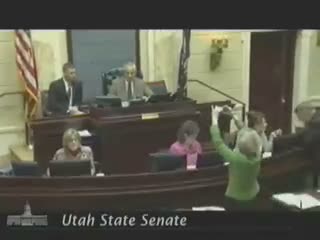
The Utah State Senate convened for its 17th day of session and moved a large set of bills through committee referral, floor action and recorded votes. After roll call confirmed a quorum, the chamber received communications from the House and the Rules Committee's recommendations for assigning bills to standing committees, which the Senate adopted.
Senators voted to reassign two bills to the Revenue and Taxation Committee. Senator Curt Dayton moved to lift Senate Bill 158 (local government funding amendments) and Senate Bill 70 (Community Development and Renewal Agency amendments) from their originally assigned committees and place them with Revenue & Taxation; the motion carried after brief discussion and a statement from Senator Bramble that Government Operations' chair agreed the reassignment was appropriate.
On third reading the Senate passed a series of bills and resolutions. Senator Jenkins presented Senate Bill 123, which inserts "school, school district and charter school" into statutory language restricting public education entities from hiring lobbyists; Jenkins said the aim is to keep money "in the classroom." The Senate passed SB123 (27 yea, 0 nay, 2 absent), and the measure will be forwarded to the House.
Senator Adams described Senate Bill 126 addressing improvement warranty bonds for special service districts, limits on their duration, restrictions on water extraction to project needs and fee clarifications; SB126 passed (27 yea, 0 nay, 2 absent) and will be transmitted to the House.
Senate Concurrent Resolution 2, introduced by Senator Jones, designates Feb. 20–27 as "Utah Saves Week" and urges programs to increase personal savings and financial literacy; Jones highlighted risks to older women's retirement security. SCR2 passed (28 yea, 0 nay, 1 absent).
Senator Morgan presented Senate Bill 48 to establish a one‑year Alzheimer's State Plan Task Force within the Division of Aging and Adult Services to assess trends, compile services and recommend actions; sponsor said funding would come from a restricted account supported by donations and grants. SB48 passed (27 yea, 0 nay, 2 absent).
Senator McAdams asked to "circle" SB124 to prepare an amendment and the Senate agreed to hold that bill for amendment.
Senate Bill 47, presented by Senator Bramble, creates a mechanism for refugees legally admitted to the U.S. to obtain Utah driver's licenses with interpreter assistance and accompanying community curriculum to help refugees pass knowledge tests and drive safely. Sponsor said about 1,100 refugees arrive in Utah annually, roughly half adults, estimating perhaps 200–300 yearly applicants for the program. Senator Thatcher asked whether non‑English reading drivers can safely interpret road signs; Bramble replied that many road signs are universal and other states have not shown a safety difference where such programs exist. SB47 passed on third reading (25 yea, 2 nay, 2 absent).
The Senate then moved to the second‑reading calendar and advanced a number of House bills for placement on the third‑reading calendar. Highlights included House Bill 209 on Workers' Compensation Premium Assessment (advanced with a motion to permit adjustments on a 3% assessment ceiling), House Bill 218 changing a single word from "building" to "facilities" to allow coordinated use of school playing fields by club sports (advanced), HB187 clarifying fire marshal appeals (advanced), HB23 expanding controlled substance prohibitions to recent synthetic cannabinoids and certain bath salts (amendments adopted and advanced), and a series of tax and administrative cleanup bills (HB36, HB37, HB38) that were placed on the third‑reading calendar.
A time‑certain floor presentation honored Navajo Code Talkers. Senator Hankins led the recognition and introduced two surviving Code Talkers and family members from the gallery. The Senate read and passed House Joint Resolution 9 urging federal agencies and Congress to support preservation of the Code Talkers' legacy and a proposed museum and veterans center; the body suspended rules and passed HJR9 by voice/roll call (24 yea, 0 nay, 5 absent), and the President signed it in open session for transmittal to the House.
On controlled substances, Senator Christiansen moved and the Senate adopted an amendment to House Bill 23 to add newly identified synthetic drugs (including brands such as "Ivory Wave") and to include certain "bath salts" (methcathinone/MDPV) among prohibited substances; the bill advanced to the third‑reading calendar.
Other floor actions: HB215 (fatality review act amendments), HB217 (change in appointment process for the Director of the Division of Healthcare Financing), HB26 (privacy protections for high‑occupancy toll lane customer data under GRAMA), and additional introduced measures were advanced or placed for later consideration. Committee reports were adopted and several bills were placed on the consent or third‑reading calendars as noted above.
At the conclusion of floor business the President announced housekeeping items (mandatory harassment training for majority members, sponsored lunch, and a sponsored dinner) and the Senate adjourned until 10:00 a.m. the next day.
Quotes from the floor include: "I'm just trying to keep the money in the classroom as best we can," (Senator Jenkins on SB123); "There is no fiscal note...it will be funded by donations and grants," (Senator Morgan on SB48); and "Refugees are not illegal aliens...this provides a mechanism to help them become gainfully employed and self sufficient," (Senator Bramble on SB47).
Next steps: the bills placed on the third‑reading calendar will return to the floor for final passage votes and bills sent to the House will proceed through House consideration or enrolling staff as appropriate.