Get Full Government Meeting Transcripts, Videos, & Alerts Forever!
Get email alerts on the SB46 Military Residency topic
No spam. Unsubscribe anytime.
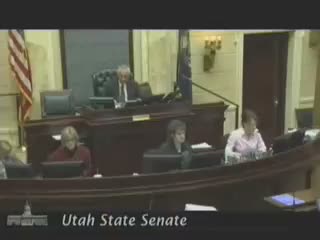
Utah Senate debates bill to ease in‑state tuition proof for military families
Summary
Senators debated SB 46, a proposal to simplify residency verification so children of deployed or transferred Utah military parents can access in‑state college tuition more easily; sponsors sought objective, streamlined proof and signaled possible amendments before third reading.
SALT LAKE CITY — Senators debated Senate Bill 46 on Feb. 22, a measure sponsored by Senator Dayton that would clarify higher‑education residency rules so children of Utah military families do not lose in‑state tuition when parents are deployed or temporarily stationed outside Utah.
Dayton told the Senate the bill is meant to be “military friendly” and described cases in which a Utah military parent’s child was charged out‑of‑state tuition because school offices required multiple documents even though the parent’s home of record listed Utah. "He had to go through quite a little process to get her registered, including showing his military card, his resident status, ... his mortgage, his income tax papers, car registration," Dayton said, recounting a constituent’s experience.
Senators pressed for clearer, objective standards to avoid administrative inconsistency. Senator Niederhauser argued that a military parent’s state of legal residence certificate that lists Utah as the home of record (the 'home of record') should be decisive: "If you have 87 through 88, you need nothing more," Niederhauser said, urging not to make the verification process unnecessarily burdensome.
Other senators raised practical questions: Senator Hillier asked whether the bill’s examples (mortgage documentation, driver's license) would unfairly favor those with mortgages versus owners with deeds, and Senator Hilliard warned that overly broad definitions could create loopholes. Senators sought options to tighten the statutory test to a small set of objective documents — for example, an active military ID plus one other objective item — rather than a long, subjective list.
Dayton said he was open to amendment before third reading and signaled he might narrow the language to make the process easier for military families. After discussion the chamber voted to place SB 46 at the bottom of the third‑reading calendar for further consideration.
Next steps: Sponsors indicated they would discuss possible clarifying amendments before the bill returns to the floor for third reading.