Get Full Government Meeting Transcripts, Videos, & Alerts Forever!
Get email alerts on the Federal State Relations topic
No spam. Unsubscribe anytime.
Congressman Matheson tells Utah legislators to pursue fiscal restraint, back natural gas opportunities
Summary
Visiting Congressman Matheson praised signs of economic recovery, cautioned about rising federal debt, urged bipartisan work on fiscal discipline and championed natural gas as a transportation fuel; he answered senators' questions on public lands and health-care law effects.
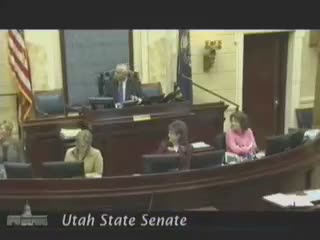
Congressman Matheson addressed the Utah Senate in a Committee of the Whole, urging lawmakers to pursue policies that encourage private-sector growth, restore fiscal discipline in Washington and consider energy options that reduce dependence on foreign supplies.
Matheson opened by noting recent economic signs: "Real gross domestic product grew at a 3.2% annual rate in the fourth quarter," and he said economists expect bipartisan tax measures to help near-term growth. He described the federal debt trajectory as a serious long-term risk and urged both parties to work toward spending restraint and consensus-based solutions.
On energy, Matheson highlighted natural gas's potential as a transportation fuel: "Natural gas gives us an opportunity that doesn't require some level of new technological innovation that doesn't exist today." He said Utah is well positioned, noting existing fueling infrastructure and urging policy that encourages private investment rather than driving capital overseas.
During Q&A senators pressed him on federal public-lands decisions and the Obama administration's evolving stance on wilderness designations. Senator Van Tassel asked Matheson to press Secretary-level officials to avoid top-down land-use approaches that create uncertainty for local energy investment; Matheson said he would raise those concerns directly and emphasized the value of locally driven solutions.
Matheson also discussed the federal health-care law, calling for granular discussion about keeping effective provisions (for example, coverage for young adults up to 26 and protections for preexisting conditions) while addressing cost drivers and incentives in the system. He suggested focusing on payment-system reform and malpractice/self-referral issues as part of broader cost-control efforts.
The visit concluded after an extended exchange with senators on energy, land use and health-care sustainability; the Senate dissolved the Committee of the Whole and thanked the congressman for the briefing.
Why this matters: A visiting member of Congress speaking to the state legislature highlights coordination between state and federal priorities on land use, energy policy and budgetary constraints — issues that affect Utah's industries and federal-state relations.