Get Full Government Meeting Transcripts, Videos, & Alerts Forever!
Get email alerts on the State Legislation topic
No spam. Unsubscribe anytime.
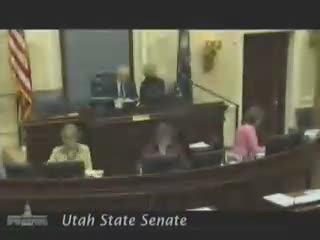
Utah Senate advances slate of House bills including capitol fee changes and fireworks rule expansion
Summary
On Day 11 of the 2011 session the Utah Senate approved multiple House bills—covering workers' compensation rate filings, capitol rental-fee scheduling, expanded class-C fireworks, mineral/petroleum literacy in schools and other technical fixes—and set them for third reading.
The Utah State Senate on Day 11 moved a package of House bills forward, approving measures ranging from workers' compensation insurer rules to changes in State Capitol rental fees and the types of fireworks permitted in Utah.
House Bill 41, a measure to set rental rates and fee exemptions for State Capitol and State Office Building rooms during the 2011 legislative session, drew the most debate. Sponsor Senator Davis defended the bill as a continuation of a policy to keep the Capitol accessible to nonprofit groups, saying it "truly keeps that principle of being the People's Building." Opponents raised concerns about a provision that privileges "preferred caterers," arguing it can shut out small local food businesses. Senator Dayton said the preferred-caterer requirement "penalize[s] financially these groups" and urged more open access for local caterers. A fiscal note showing a projected negative $79,000 relative to previously exempted activity was discussed; Senator Davis said the sum reflected money that had not been collected under past practice. After debate Senator Davis withdrew a motion to pass under suspension and later the bill was read a third time and placed on the third-reading calendar with a recorded tally of 22 yea, 3 nay, and 4 absent.
Other bills the Senate advanced included:
- House Bill 27 (workers' compensation rate filings): Sponsor Senator Valentine said the bill permits insurers to offer multiple rate tiers within a single insurer or across companies; the Senate voted to advance the bill (26 yea, 0 nay, 3 absent).
- House Bill 29 (business entity mergers): Sponsor Senator Stevenson said the bill allows corporations to merge with other types of business entities and clarifies board procedures; the bill passed to third reading (24 yea, 0 nay, 5 absent).
- House Bill 22 (Fire Prevention and Fireworks Act amendments): The measure creates an additional grouping of class-C fireworks (allowing so-called "cakes" and other items that do not leave the ground but may produce higher spark effects) while keeping items that physically leave the ground prohibited; it passed (24 yea, 1 nay, 4 absent). Safety and fire-code adoption were central points in debate.
- House Bill 25 (Mineral and Petroleum Literacy): Sponsor Senator Dayton described a $100,000 allocation from the oil- and gas-related conservation account (not the general fund) to produce curriculum and teacher training on mineral and petroleum literacy; the Senate advanced the bill (26 yea, 0 nay, 3 absent).
- Several technical and administrative bills passed or were advanced, including measures on election-official funds, water-rights technical fixes, insurance producer errors-and-omissions coverage, and updated Labor Commission electronic communications.
Votes at a glance (selected): HB27 — advanced to third reading (26–0; 3 absent). HB29 — advanced (24–0; 5 absent). HB30 — uncircled then advanced (23–0; 6 absent). HB41 — placed on third reading (22–3; 4 absent). HB12 — advanced (23–0; 6 absent). HB25 — advanced (26–0; 3 absent). HB22 — advanced (24–1; 4 absent). HB43 — advanced (25–0; 4 absent). HB188 — advanced (26–0; 3 absent).
Why this matters: HB41 affects public access and the fee structure for using state facilities during the session and touched off a broader discussion about balancing public access, revenue impacts and fair opportunities for small, local caterers. HB22 updates long-standing fireworks rules that bear directly on public safety and local enforcement. HB25 channels modest, non-general-fund education money toward instruction about a major Utah industry.
The Senate recessed or placed the advanced bills on the third-reading calendar for final passage later in the session. Several measures were noted as having been transmitted from the House and referred to committees earlier in the day.