Get Full Government Meeting Transcripts, Videos, & Alerts Forever!
Get email alerts on the State Of Judiciary topic
No spam. Unsubscribe anytime.
Utah chief justice cites reforms and access gains, announces leadership transition
Summary
Chief Justice Christine Durham told the Senate the state courts have expanded problem-solving courts, moved to electronic records and improved services for self-represented litigants, requested modest funding to expand a self-help center, and announced Associate Chief Justice Matthew Durant will succeed her as chief justice on April 1.
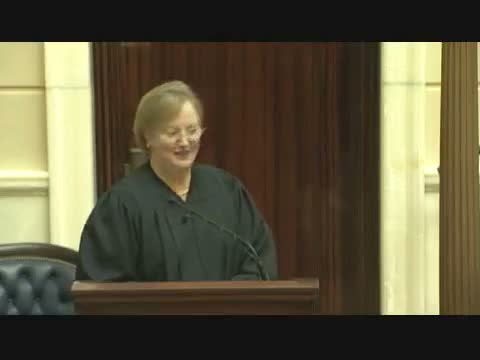
Chief Justice Christine Durham told the Utah State Senate on the floor that the state's judicial branch is "doing remarkably well," pointing to justice court reforms, expanded problem-solving courts and a shift to electronic records as evidence of improved fairness and access.
Durham spoke to senators as members of the Utah Supreme Court looked on, and she opened by thanking legislative leaders for their support. She listed specific changes the courts have implemented over the past decade: reforms in justice court selection and retention and compensation; statewide operational standards; and a new statewide automated case-management and records system.
Those changes accompany broader efforts to increase transparency and efficiency, Durham said. She cited publication of performance measures and noted that Utah’s courts received national recognition for their program of performance transparency. The court has also expanded problem-solving courts, now operating 46 drug courts, and has mental-health and juvenile problem-solving courts in several judicial districts, she said.
Durham described steps to help people who appear without lawyers: an online court-assistance program, a self-help center and online forms, all part of an effort to broaden access to justice for self-represented litigants. She also described a near-complete migration from paper to an electronic record—"e-filing, e-warrants, e-payments, e-transcripts"—that she said is central to the courts’ business-model changes.
The chief justice highlighted two other system-level initiatives: a new statewide juvenile information system called CARE and the Initiative on Utah Children in Foster Care (IOU), a cross-branch effort to coordinate courts, education, child welfare, medical and mental-health providers, and community partners to support vulnerable children in foster and kinship care.
Durham cautioned that the courts still face resource constraints but said they are not asking broadly for restoration of lost funding. She requested a modest, targeted increase to define and expand the statewide self-help center to better serve tens of thousands of Utahns who appear without legal counsel.
She provided caseload context for the request, saying the state courts handle the vast majority of litigation affecting ordinary citizens and enumerating recent filings she said included more than 129,000 business filings, about 53,500 cases affecting families and children, roughly 76,600 traffic cases and about 17,300 criminal cases, stressing the courts’ broad impact on families, public safety and the economy.
Durham also announced a planned leadership transition. She said she will step down as chief justice in March and that the court unanimously selected Associate Chief Justice Matthew Durant to begin a term as chief justice on April 1, allowing for an orderly handover.
Senators responded with expressions of appreciation. Senator Romero and others recognized Durham’s national profile and many years of service. The Senate briefly met as a Committee of the Whole for the address then dissolved the committee afterward.
Durham concluded by reiterating the judiciary’s commitment to access and fairness and thanking legislators for their past support. The court invited senators to review district-level performance and survey results on the courts’ website.
The Senate took no formal vote on the funding request during the floor appearance; procedural business followed.