Get Full Government Meeting Transcripts, Videos, & Alerts Forever!
Get email alerts on the Legislative Roundup topic
No spam. Unsubscribe anytime.
Senate advances wide-ranging package: votes move dozens of bills to House
Summary
The Utah Senate cleared a large number of bills across topics including water rights, boundaries, education funding, public safety, and administrative updates. Many passed under suspension of the rules and were sent to the House for further consideration or signatures.
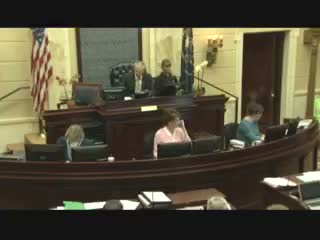
During a lengthy floor session the Utah State Senate passed and transmitted a broad package of bills to the House, covering a mix of consent items, technical fixes and policy changes.
Key actions recorded on the Senate floor included passage (often unanimous or near-unanimous) of items on the consent calendar such as First Substitute HCR 5 (regional correctional facilities), HB 358 (instream flow amendments), as well as a run of third-reading bills on subjects ranging from Medicaid ER rules (HB 141), human-trafficking clarifications (HB 163), asset-protection trust changes (HB 222), radiation control improvements (HB 124), property and probate code revisions (HB 347, HB 327-series), air-quality mitigation task-force creation (HB 168), and boundary amendments (HB 366 and HB 367).
The Senate also advanced budgetary and appropriations items, including current fiscal-year supplemental appropriations (House Bill 3) and second-substitute Senate Bill 7 on state and higher-education compensation appropriations. Procedural motions were frequent: senators repeatedly used circling and uncircling, suspension of the three-reading constitutional requirement, calls of the Senate, and motions to reconsider to manage a full agenda.
Several bills passed unanimously or with overwhelming support; the transcript records many roll-call tallies (for example: HB 141 recorded 24 yeas, HB 163 recorded 25 yeas, HB 168 recorded 27 yeas). The body recessed after recognizing a visiting Iraqi delegation and scheduled a short afternoon recess.
Because many measures were handled under consent or suspension of the rules, the Senate calendar moved quickly; bills were transmitted for the Speaker—s signature where required or placed on the concurrence calendar.