Get Full Government Meeting Transcripts, Videos, & Alerts Forever!
Get email alerts on the Judiciary State Of The Judiciary topic
No spam. Unsubscribe anytime.
Utah Chief Justice Matthew B. Durant praises court efficiency, warns of access strains
Summary
Chief Justice Matthew B. Durant told the Utah Senate that investments in electronic filing and self‑help services improved court efficiency but warned rising unrepresented litigants, language needs and workload pressures in the Eighth Judicial District require legislative attention.
Chief Justice Matthew B. Durant told the Utah Senate that the state’s courts have become more efficient and transparent but face growing access challenges that will require legislative support.
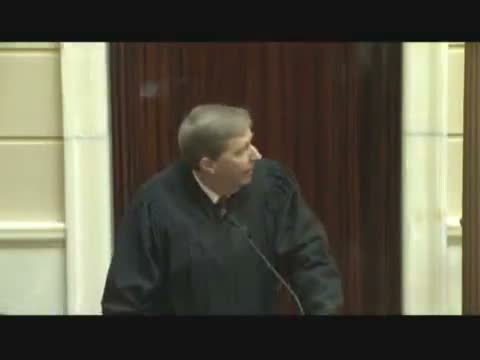
Durant, speaking in the Senate chamber, said Utah’s nonpartisan judicial selection process and strong working relationship with the Legislature have helped the judiciary weather budget reductions. “To have a judiciary committed to the rule of law, ... dedicated to fair and impartial justice, not only benefits those who now do business in our state, but it plays a key role in decisions being made by those who are considering locating here,” he said.
Durant credited technology and organizational changes for improvements after recent staff reductions. He reported that the judiciary reduced the average age of pending cases by about 34% while operating with roughly 10% fewer staff and said the courts are “almost to the finish line of operating in a fully electronic environment.” He said, “We are now paperless statewide for all civil cases filed after 07/01/2012,” and listed efficiency, security and transparency among the benefits.
The chief justice described steps to make courts more accessible to people without lawyers, including a statewide self‑help center funded by the Legislature and an online Court Assistance Program (OCAP). Durant said OCAP helped prepare roughly half of divorce petitions last year and the self‑help center is on pace to assist about 16,000 Utahns in the year cited. He illustrated the programs’ impact with a guardianship case in which grandparents used OCAP to obtain legal guardianship for their granddaughter.
Durant also highlighted challenges. He said the courts required interpretation in 57 languages last year, that many litigants have substance‑use or mental‑health issues, and that the share of self‑represented parties is rising (he cited about 56% of domestic cases involving no attorney). “This should be troubling to all of us,” he said, urging continued legislative support for access initiatives.
On transparency, Durant noted the Judicial Council’s recent rule change allowing media coverage using audio and video in trial courts, saying the change will make Utah courts “even more transparent and accountable.”
Durant closed by flagging a persistent workload imbalance in the Eighth Judicial District (Uintah, Duchesne and Daggett counties), where he said visiting judges and other temporary measures have been used while the need for permanent judgeship relief has grown. He noted Senator Van Tassel filed legislation to address the long‑standing need and asked the Senate for support.
After the address the Senate unanimously agreed to spread Durant’s remarks on the Senate Journal.