Get Full Government Meeting Transcripts, Videos, & Alerts Forever!
Get email alerts on the Legislative Floor Actions topic
No spam. Unsubscribe anytime.
Utah Senate moves more than 20 bills to third reading, advances data‑security, election and tax changes
Summary
The Utah Senate spent its floor session advancing a broad package of bills—including retirement eligibility clarifications, transit customer data protections, rules for research with controlled substances, and new state data‑security requirements—moving most measures to third reading with largely unanimous support.
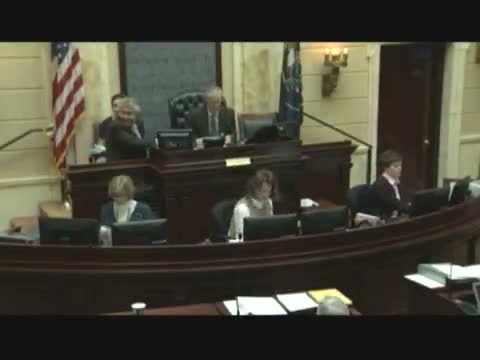
SALT LAKE CITY — The Utah State Senate advanced more than 20 bills during a single floor session, moving measures on retirement rules, elections, taxes and data security to third reading and, in most cases, clearing them with overwhelming or unanimous votes.
Senator Jerry Weiler introduced Senate Bill 10, which “clarifies that elected officials and part‑time members of public entities do not need to terminate those positions if they wish to retire from another full‑time public employee position,” he said, adding the change is intended to avoid unintended resignations triggered by retirement rules. The clerk recorded 26 'yay' votes, 0 'nay' and 3 absent to move SB 10 to third reading.
Senator Van Tassel described Senate Bill 12 as a response to the transit authority’s adoption of electronic fare systems. “As we take UTA to the next step… it became necessary… that we put in protection for financial information,” he said; the Senate recorded 25 'yay' votes, 0 'nay' and 4 absent to advance the bill.
Senator Jones presented legislation (SB 14) to ease regulatory requirements that apply to researchers handling controlled substances, telling colleagues the measure removes clinical restrictions that unduly impede biomedical investigation. The Senate moved that bill to third reading unanimously.
Privacy and data security featured in a high‑profile presentation by Senator Reid, who framed SB 20 as a direct response to a large breach affecting Medicaid and CHIP beneficiaries. “My wife was one of those whose information was breached,” he said, and described SB 20 as requiring the Department of Technology Services to adopt industry best practices and to create an expert advisory committee. Reid said agencies would notify legislative leaders when budget constraints prevent following a best practice. The bill was advanced to third reading with 27 'yay' votes and 2 absences.
On elections, the chamber advanced several bills refining absentee ballots and emergency election timing. Senator Knudson said SB 24 addresses recent problems with third‑party collection of absentee ballot applications and clarifies exceptions for hospitalized or disabled voters; the Senate advanced SB 24 with 28 'yay' votes, 0 'nay', 1 absent. SB 25 authorizes the lieutenant governor to alter voting times or methods during a declared emergency to protect absentee and military overseas voting; it moved forward with largely unanimous support.
Tax and administrative reforms also progressed. Senator Stevenson sponsored SB 33 to resolve a double‑taxation issue when related entities buy and lease equipment internally; he noted a fiscal estimate in excess of $1 million and promised follow up from the fiscal analyst before third reading. Senator Harper presented SB 35, raising the small‑business personal property exemption from $3,500 to $10,000, which the sponsor said would relieve reporting burdens for more than 26,000 businesses; the Senate moved SB 35 to third reading with 26 'yay' votes and 1 'nay'.
Floor managers repeatedly used the ‘circle’ procedure to defer bills that needed amendment or further work; for example, SB 28 (boards and commissions amendments) was circled for future consideration after the sponsor and others discussed possible amendments.
Most bills recorded near‑unanimous support on voice or roll‑call votes. Floor leaders reminded sponsors that bills placed on the third reading calendar still require House sponsors before final passage in the full Legislature. President Niederhauser adjourned the session after the morning’s business, with the Senate scheduled to reconvene at 10 a.m. the next day.
Actions ahead: sponsors said they will bring fiscal office follow‑up on several measures and that amendments to circled bills may be offered on the third reading calendar.