Get Full Government Meeting Transcripts, Videos, & Alerts Forever!
Get email alerts on the Legislative Votes topic
No spam. Unsubscribe anytime.
Votes at a glance: key bills passed, tabled or reassigned by the Utah Senate
Summary
The Senate advanced a broad package of bills on second and third reading (veterans’ college credit, injured worker reemployment, rural waste disposal and more), tabled an insurance bill with fiscal impact, reassigned a fire code amendment, and transmitted several bills to the House; roll-call tallies are included where recorded.
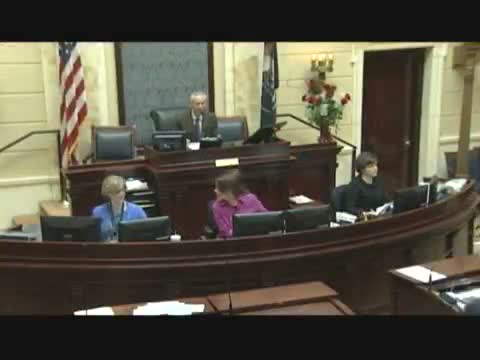
SALT LAKE CITY — During a full session the Utah State Senate passed a number of bills on second and third reading, reassigned at least one house bill, and tabled an insurance measure that senators said has a fiscal impact.
House Bill 32 (college credit for veterans) passed on third reading after Senator Knudson described provisions requiring colleges and universities to notify veterans and evaluate military training for academic credit. The Senate recorded a roll-call result of 27 yay, 0 nay, 2 absent.
House Bill 10 (injured worker reemployment amendments) passed after Senator Bramble said the bill establishes criteria for reemployment plans but does not change the Office of Rehabilitation Services; the transcript records the passage and the enrolled copy will be sent to the House (roll-call recorded by the clerk).
House Bill 13 (rural waste disposal) was explained by Senator Hankins as allowing rural residents to bury their own waste with a one-time deed notice to inform prospective buyers; the Senate recorded 24 yay votes and 5 absences and passed the bill.
Senator Vickers presented SB 138 (Controlled Substance Act Amendments) on the consent calendar explaining a pharmacy-board recommendation to allow multiple prescriptions on a pad; the president directed a unanimous aye vote and the bill passed by unanimous consent.
The Senate adopted committee reports and assigned multiple bills to standing committees (for example, SB 87 to Business & Labor; HB275 to Economic Development; HB36 and HB96 to Education; HJR10 to Government Operations). The chamber also lifted and reassigned a first substitute of House Bill 245 (state fire code amendments) from Government Operations to Business & Labor to reflect appropriate committee handling of building code issues.
Second substitute House Bill 24, an insurance-related measure, was identified by Senator Bramble as carrying a fiscal impact between a restricted account and the general fund. Senators agreed to a technical amendment and then voted to table HB 24 pending budget clarification and potential future amendments.
Other bills that passed and were transmitted to the House include HB 21 (system of care for minors in state custody, roll call 28 yea), HB 33 (reauthorization of the Utah Commission on Service and Volunteerism, recorded 22 yea, 1 nay, 6 absent), HB 35 (reauthorization of the Utah Health Data Authority Act, recorded 22 yea, 0 nay, 7 absent) and SB 90 (residency statute clarifications, recorded 20 yea, 0 nay, 9 absent).
Several bills underwent substitution and amendment on the floor (for example, Senate Bill 53 was replaced with a second substitute after stakeholder negotiation and subsequently passed and was sent to the House). Senators also discussed and agreed to technical amendments to other bills and circulated citations recognizing community leaders and visiting delegations.
The Senate adjourned after announcing caucuses and evening events and directed that enrolled copies be signed in open session and transmitted as required by procedure.