Get Full Government Meeting Transcripts, Videos, & Alerts Forever!
Get email alerts on the Legislation topic
No spam. Unsubscribe anytime.
Utah Senate advances sweeping package: bills on healthcare, education, public safety and infrastructure pass on day 45
Summary
On day 45 of the legislative session the Utah Senate moved dozens of bills through consent, concurrence and third reading, passing measures on Alzheimer's policy, distracted-driving rules, rural physician loan repayment, juvenile offender amendments, and more; many items were sent to the House or placed under rules.
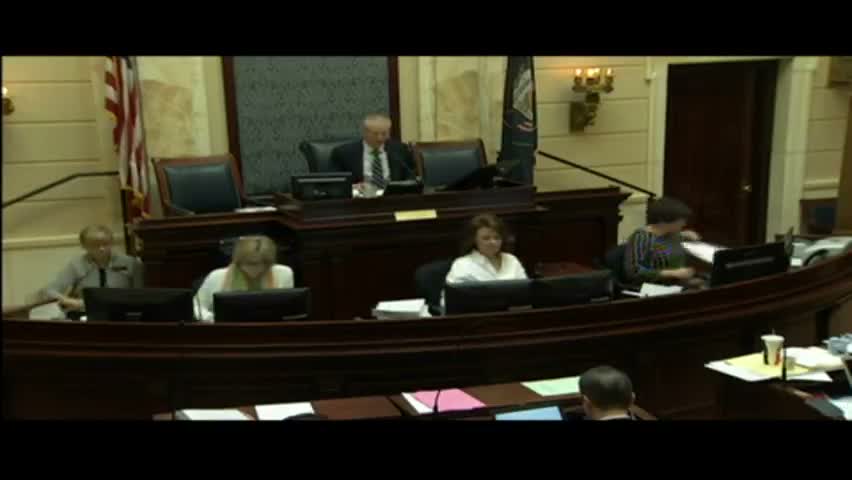
On day 45 of the 2015 Utah Legislature the State Senate cleared a long consent and concurrence calendar, approving a broad set of bills on healthcare, education, public safety, and administrative alignment and returning some items to rules or the House for further action.
The Senate approved, often by unanimous or near-unanimous margins, a mix of policy and technical bills. Among the earlier consent items, the body passed House Bill 352 (title insurance reporting and assessment amendments) and moved other fiscal-note items onto second- or third-reading calendars. Senator Shiozawa summarized first substitute House Bill 249 as granting adults conceived by artificial insemination “the right after becoming adult to request non-identifying medical history of the donor,” and the bill was carried forward without recorded opposition on the floor.
The upper chamber also took up several substantial concurrence items. First substitute Senate Bill 76 (rural physician loan repayment) was amended in the House to add an appointed executive director seat and to clarify eligibility for physicians practicing in rural counties; Senator Hinkins told colleagues that $400,000 had been appropriated while only $300,000 was needed, allowing $100,000 to lapse back to executive appropriation. The Senate concurred; the measure passed on a recorded vote and will return to the House for the speaker's signature.
A notable policy vote came on second substitute Senate Bill 297, addressing protections for religious expression and related marriage-office procedures after lengthy debate. Sponsors and supporters described changes intended to preserve clerk-office services while protecting religious liberties; after floor debate the Senate recorded 25 yea votes, 3 nays and 1 absent and sent the bill to the House.
On public-safety legislation the Senate adopted an industry-sensitive amendment to distracted-driving legislation (second substitute House Bill 63) to clarify that push-to-talk and certain hands-free dispatch features used in construction and trucking would be allowed; that bill passed on a roll call.
Education and health measures also moved forward. The chamber passed House Bill 175 directing the Department of Health to treat Alzheimer's disease and related dementias as a public-health issue and implement the state plan. The Senate also approved a charter-school funding task force (House Bill 444), moved Utah Futures administrative alignment from Workforce Services to UEN/UATN (Senate Bill 243), and advanced bills authorizing pilots and Medicaid-waiver actions for children with complex medical conditions (House Bill 199).
Several public-infrastructure and emergency-communications measures were adopted. Senators approved a substitute for House Bill 343 to strengthen the Utah Communications Authority and improve E-911 interoperability; sponsors noted a one-time budget amount already included in the session's appropriations package for the work.
Votes at a glance (selected floor outcomes reported by the Senate): - House Bill 352 (Title insurance reporting and assessment amendments): Passed; recorded as 22 yea, 0 nay, 7 absent (unanimous among those present). - First substitute Senate Bill 76 (Rural physician loan repayment program): Concurred with House amendments; passed on recorded vote (25 yea, 0 nay, 4 absent). - Second substitute Senate Bill 297 (Protections for religious expression and related provisions): Passed 25 yea, 3 nay, 1 absent; sent to House for signature. - Second substitute House Bill 63 (Distracted driver amendments, including push-to-talk carve-outs): Passed on roll call (recorded tallies reported from the floor). - House Bill 175 (Alzheimer's State Plan Amendments): Passed 28 yea, 0 nay, 1 absent. - First substitute House Bill 199 (Pilot program for children with disabilities/complex medical conditions): Passed 25 yea, 0 nay, 4 absent. - Second substitute House Bill 343 (Utah Communications Authority / E-911 amendments): Passed under suspension of rules; sponsors said the fiscal note of roughly $20 million was already in the budget as one-time funding. - House Bill 444 (Charter School Funding Task Force), as amended: Passed after suspension of three-reading requirement; directs a task force to study charter-school finance.
What the votes mean and next steps Many of the bills approved by the Senate were sent back to the House for the Speaker's signature or were placed on calendars for further House consideration. Multiple measures that required suspension of the Senate's three-reading rule were adopted by recorded vote. Some bills—particularly those with fiscal notes or interchamber disagreements—were routed to rules or conference committees for further technical or funding work.
On procedural matters the Senate recessed for caucus and planned to return at 2:00 p.m.; several items were left for the rules committee or additional scheduling. The chamber's actions on day 45 reflect a mix of broad bipartisan consent, targeted amendments to industry or constitutional concerns, and several competitive roll-call votes on higher-profile policy items.
Representative excerpts from floor remarks capture the tenor of debate: Senator Dabakis remarked that national coverage had labeled the religious-expression compromise the "Utah Compromise," while Senator Jenkins explained a push-to-talk amendment by noting how construction and trucking use that feature for safety-critical communications. Senator Bramble and others stressed fiscal and technical fixes where language had caused unintended consequences.