Get Full Government Meeting Transcripts, Videos, & Alerts Forever!
Get email alerts on the Legislation Roundup topic
No spam. Unsubscribe anytime.
Utah Senate advances slate of bills on lobbyist disclosure, eminent domain, education savings and pay for tax commissioners
Summary
The Utah Senate moved multiple bills toward final passage, approving amendments to lobbyist-reporting rules, clarifying eminent-domain rights for original grantors, substituting changes to the Utah Educational Savings Plan and advancing a measure to align tax-commissioner pay with district court judges.
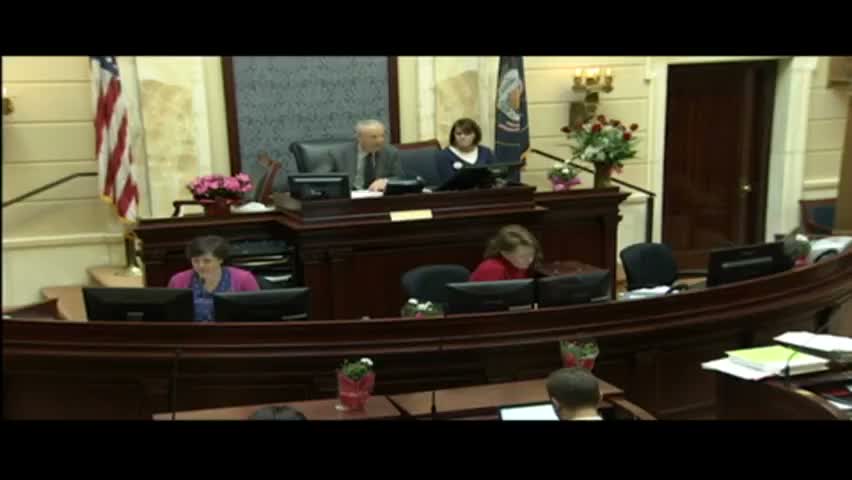
SALT LAKE CITY — The Utah Senate on a busy floor day advanced and in several cases approved a series of measures addressing lobbyist reporting, eminent domain, education-savings tax credits and state compensation rules.
Senator Wyler introduced First Substitute Senate Bill 31 to codify internal guidance on what counts as a meeting, event or activity for lobbyist-disclosure purposes and accepted a friendly amendment from Senator Bramble clarifying that travel to and from exempt events is likewise exempt. "What Senate Bill 31 does is it basically codifies into our rules, the Emily Brown memo," Wyler said, adding the change is mostly clarifying. The Senate recorded 27 yea votes, 0 nay votes and 2 absences on the measure as read for a third time.
Senator Hilliard described Senate Bill 68 as a technical fix to make clear that an original grantor's post-condemnation right of first refusal is personal and not assignable. "The main thrust of the bill is to make it clear that this is not an assignable right the grantor has," Hilliard said, explaining the change aligns different condemnation statutes. Senators raised questions about cases in which title is held in a single name but effectively owned by a family; the bill was taken up for recorded consideration and ordered for third reading.
Lawmakers also substituted and approved changes to the Utah Educational Savings Plan in Second Substitute Senate Bill 64. Sponsors said the bill (1) clarifies which Utah taxpayer may claim the state income tax credit for UESP contributions, (2) allows a taxpayer to direct part of a state income tax refund to a UESP account beginning in the 2016 tax year, and (3) treats certain grantor trusts the same as joint filers for credit purposes. Senator Weiler and Senator Bramble described the substitute as correcting an unintended tax-treatment that had reduced the incentive for some trust-owned accounts; the second substitute was read for a third time after recorded votes.
Senator Wyler urged the body to pass Senate Bill 71, which would tie compensation for the four state tax commissioners to the same pay scale as district court judges. Wyler argued the tax commissioners perform quasi-judicial functions and should be paid commensurately. Colleagues raised concerns about automatically tying those salaries to judges, and about the fiscal impact; Wyler cited a fiscal estimate "as much as $25,200 ongoing from the general fund, and $20,700 ongoing from the education fund, and $18,700 ongoing from the state tax commission administrative charge account." After debate the Senate moved the bill for further consideration.
Beyond those measures, the Senate considered and approved first or second readings, substitutions or referrals for numerous other bills: SB 14 (renewable energy tax-credit conforming amendments), SB 62 (certified tax rates following school-district divestiture), SB 70 (geographic distribution requirements for initiative signatures), SB 32 (limits and reporting for small awards/food) and SB 93 (uniform commercial code filing amendments to address bogus liens). Several substitutes were adopted on the floor and multiple items were advanced to third reading.
Votes at a glance (tallies recorded on the floor): • SB 31 (Lobbyist Disclosure) — 27 yea, 0 nay, 2 absent (ordered read for third time) • Second Substitute HB 81 (local school-board meeting locations) — recorded as passing; Senate noted signatures and will be signed by the president • First Substitute SB 70 (geographic diversity) — 24 yea, 0 nay, 5 absent (ordered read for third time) • SB 14 (renewable energy tax-credit conforming) — 24 yea, 0 nay, 5 absent (ordered read for third time) • SB 62 (certified tax rates) — recorded as 26 yea, 0 nay, 3 absent (ordered read for third time) • Second Substitute SB 64 (UESP) — 27 yea, 0 nay, 2 absent (ordered read for third time) • SB 71 (tax-commissioner compensation) — advanced to third reading after recorded vote (tally recorded in transcript) • SB 32, SB 85, SB 93 — substitutes adopted and advanced to third reading (tallies recorded on the floor)
Senators also recognized student representatives from Utah Valley University and the Utah Student Association, who presented a resolution urging higher-education policies to help students prepare for and complete college. The Senate adjourned with a motion to reconvene at the scheduled time.
What happens next: several measures were ordered for third reading; those bills will return to the floor for final passage votes under the Senate's third-reading procedures.