Get Full Government Meeting Transcripts, Videos, & Alerts Forever!
Get email alerts on the Traffic Fines topic
No spam. Unsubscribe anytime.
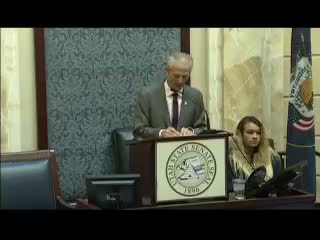
Senate approves cap on municipal ticket revenue after heated Manaway debate; SB100 passes 18–8
Summary
After extended debate over whether local traffic enforcement in the canyon amounts to 'policing for profit,' the Utah Senate passed SB100, a bill that limits how much a municipality may retain from fines to 25% of its budget. Supporters said the bill curbs perverse incentives; opponents warned it would reduce local public-safety funding.
The Utah State Senate on Day 29 passed Senate Bill 100, a measure that would cap how much a municipality may retain from traffic and fine revenue at 25 percent of its total budget. Senators voted 18–8, with three absent, to advance the measure for third-reading action and further processing.
Senator Hilliard, sponsor of the bill, told colleagues SB100 was aimed at ending what he called "policing for a profit," citing constituent complaints and television reports about enforcement practices along the canyon road near the town of Manaway. "This is a bill about policing for a profit," Hilliard said, arguing that cities should not be financially incentivized to issue excessive citations.
Supporters said the cap would reduce incentives for local governments to rely heavily on citations for general revenue and would protect motorists who drive through municipal corridors that are not their home communities. Hilliard and other proponents described research and anecdotal complaints showing frequent, high fines issued in the corridor; Hilliard said the fiscal note on the bill was modest and he did not expect a large statewide revenue impact.
Opponents, including several senators who represent nearby communities, warned the proposal could reduce public-safety capacity in small towns that use citation revenue to fund courts, police, and volunteer fire and rescue services. A letter from Manaway's mayor, read to the chamber during debate, said that in a recent 65-day period officers there issued about 220 citations — of which the mayor reported 138 were for speeds over 75 mph and 35 over 80 mph — and that citation proceeds fund court costs, public defenders, interpretation services, the justice of the peace, the court clerk and the local volunteer fire-and-rescue apparatus.
Senator Thatcher and others suggested alternatives such as improved signage and state involvement on a state highway that passes through small towns, while some senators emphasized that enforcement should prioritize safety and not revenue. The chamber heard arguments that the state, through UDOT or the Utah Highway Patrol, shares responsibility for the state road that runs through the town.
After more than an hour of floor exchanges that included constituent anecdotes and a town letter summarized to the body, the clerk announced the roll-call: Senate Bill 100 "having received 18 yay votes, 8 nay votes, and 3 being absent, shall be read for a third time," a procedural step that moves the measure forward under the Senate's rules.
Next steps: The Senate ordered SB100 advanced as recorded; additional committee action or engrossment steps may follow per the Legislature's calendar.