Get Full Government Meeting Transcripts, Videos, & Alerts Forever!
Get email alerts on the Legislative Votes topic
No spam. Unsubscribe anytime.
Utah Senate advances base budgets, extends Enterprise Zone and passes multiple bills
Summary
In a busy floor session the Utah Senate unanimously passed a slate of budget bills and a series of House bills, including an extension of the Enterprise Zone repeal date and changes to water-conveyance and vehicle-registration rules. Several bills passed under suspension of rules and three-reading requirements.
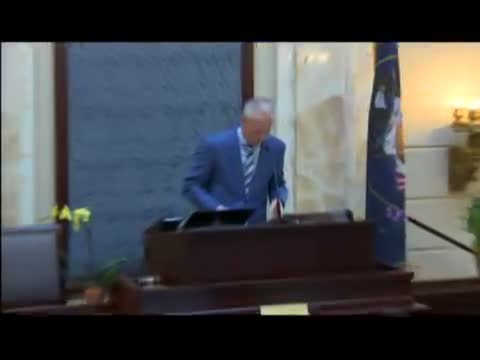
The Utah Senate convened for a floor session that resulted in unanimous passage of multiple base-budget measures and several House bills sent to the chamber earlier by the House.
Senate leaders used suspension of the rules and three-reading waivers to advance base budgets for higher education, economic development, infrastructure and other state functions. First Substitute Senate Bill 1, the higher education base budget presented by Senator Vickers, passed under suspension of the rules with a recorded 28-0 vote. Sponsors said the substitute includes modest across-the-board reductions and reallocated funds to address campus needs.
Also on the calendar, the Senate adopted House Bill 22, an Enterprise Zone sunset amendment sponsored in the Senate by Senator Okerlund that extends the repeal date of the Enterprise Zone Act by 10 years, moving the next sunsetting to 2028. "HB 22 amends the Enterprise Zone sunset ... so that it is now going to be sunsetting again 2028," Senator Okerlund said when moving the bill; the Senate recorded 25 yay, 0 nay, 4 absent on that vote.
The chamber also passed House Bill 23 (Office of Economic Development amendments), which sponsors said streamlines GOED operations, revises the private activity bond treatment and reorganizes certain positions inside the agency; the bill passed 26-0. The Senate adopted a first substitute to Senate Bill 96 (canal amendments), which creates a process for property owners and owners of water conveyance facilities to proceed with modifications and directs the Office of Property Rights to offer mediation and arbitration when requested. Sponsor Senator Hinkins described the bill's purpose; another senator noted the bill’s scope affects roughly 6,500 miles of canals and ditches.
Senate Bill 55, a motor-vehicle registration amendment sponsored by Senator Harper, clarifies that a person who can show current registration after stolen or missing plates/decals will have fines waived; the sponsor said the change is meant to protect people victimized by theft and prevent double fines. The bill passed with unanimous recorded support.
Several other first-substitute base-budget bills (SB4, SB5, SB6, SB7) were substituted and adopted under the same suspension procedures; committee sponsors and subcommittee chairs outlined reallocations, restored funding for specific programs and one-time appropriations that were included in the substitutes.
Votes at a glance - HB 22 (Enterprise Zone Sunset Amendment): passed; recorded 25 yay, 0 nay, 4 absent; motion moved by Senator Okerlund (topic intro: SEG 641; finish: SEG 665). - HB 23 (Office of Economic Development Amendments): passed 26-0 (SEG 666–732). - SB 96 (First Substitute, Canal Amendments): passed 27-0; sponsor: Senator Hinkins (SEG 733–844). - SB 62 (First Substitute, Expungement): first substitute adopted and then circled for further review (SEG 846–943). - SB 55 (Motor Vehicle Registration Amendments): passed 27-0; sponsor: Senator Harper (SEG 946–1100). - SB 1 (First Substitute, Higher Education Base Budget): passed 28-0 under suspension of rules (SEG 1105–1234). - SB 4, SB 5, SB 6 (first substitutes; business/economic development, retirement/independent entities, infrastructure/general government): substituted and passed under suspension of rules (SEG 1236–1494).
What it means and next steps Most items passed the Senate unanimously and were sent to the House where applicable. Several bills were "circled" (set aside briefly) to give senators time to digest substitute language before final action; other items were placed on time certain for later floor consideration. The Senate recessed to continue its work later in the day.
Sources and provenance: primary reporting based on the Senate floor transcript (topic start/end spans recorded in provenance).