Get Full Government Meeting Transcripts, Videos, & Alerts Forever!
Get email alerts on the Transportation Tolling topic
No spam. Unsubscribe anytime.
Utah Senate debates third substitute of bill to authorize license-plate electronic tolling on new-capacity roads
Summary
Senators debated the third substitute of Senate Bill 71, which would allow UDOT to collect electronic tolls using license-plate identification on state roads with newly added capacity; sponsors said the measure targets congestion corridors such as Little Cottonwood Canyon, while colleagues pressed for privacy, reciprocity and equity safeguards. The transcript records a roll-call to read the bill for a third time but does not include a final tally.
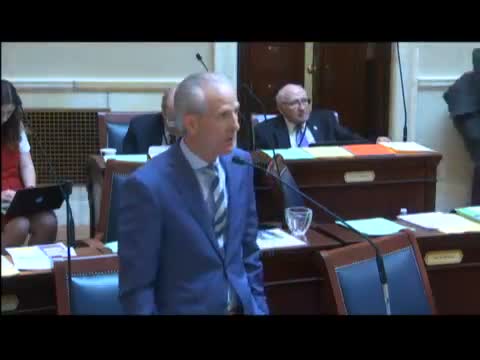
Senators spent a substantial portion of the floor session discussing the third substitute of Senate Bill 71, a measure that authorizes the Utah Department of Transportation (UDOT) to use license-plate identification for electronic toll collection on state roads that receive new capacity.
Sponsor Senator Niederhauser said the bill "allows electronic tolling, through identification of license plate," and emphasized the measure does not authorize tolling of existing road capacity without further legislative or commission approval. "It does not allow towing that hasn't been allowed before…they can only use it to collect a toll, and then they have to get rid of the information," he said during his presentation.
The sponsor framed the bill as a traffic-management tool for corridors where construction adds capacity and conventional approaches have failed to control congestion. He cited Little Cottonwood Canyon as the motivating example, noting prior appropriations to add a lane and the ongoing NEPA process tied to future project decisions.
Lawmakers on the floor probed how the bill handles out-of-state vehicles and where toll revenue would go. Senator Fillmore asked, "What would be the process when UDOT captures an out-of-state license plate on any toll road?" Senator Niederhauser replied that the bill does not define revenue allocation, and that UDOT would determine uses through public processes and agreements, including reciprocal arrangements with other states.
Privacy and enforcement questions came up repeatedly. Senator Hilliard pressed whether the bill's amendments impose penalties connected to vehicle registration when fines go unpaid; the sponsor responded that rule-making and administrative exceptions (for stolen vehicles, for example) would be handled by UDOT and through administrative rules.
Supporters defended the policy on fiscal grounds: Senate floor remarks noted an ongoing construction plan that relies on roughly $600 million in sales-tax funding for roads and argued that gas-tax revenue is declining as a funding source. One senator summarized the fiscal context: "Gas taxes are becoming increasingly irrelevant…we need to have another tool in our toolbox to fund infrastructure." The sponsor called the bill "one of the first steps" toward additional options for transportation funding.
A roll-call vote was called on whether to read the third substitute of SB71 for a third time; the transcript records the roll call being ordered and names being read but does not include a final tally in the provided segment. The bill’s text specifies that captured license-plate data may be used only to collect tolls and must be purged after collection; uses of revenue and implementation details were left to subsequent UDOT processes and rule-making.
Next steps recorded in the transcript: the Senate held a roll-call on the third-read motion for SB71 and then continued to other items on the calendar. The transcript does not record a formal passage tally for the third-substitute of SB71 in the provided excerpt.