Get Full Government Meeting Transcripts, Videos, & Alerts Forever!
Get email alerts on the Notary Reform topic
No spam. Unsubscribe anytime.
Senate advances remote-notary bill amid security questions
Summary
The Utah Senate advanced first substitute House Bill 52 to be read for a third time after debate on remote online notarization. Sponsor Sen. Cullimore said the bill modernizes notary law and aligns with uniform notary standards; critics raised data-security concerns; the procedural vote to advance the bill passed 25–0.
The Utah Senate advanced first substitute House Bill 52, a measure to allow remote online notarization, on a procedural vote after floor debate on the technology’s safeguards.
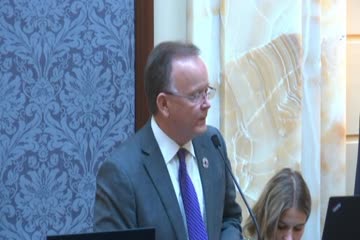
Senator Curt Cullimore, sponsor of the measure, told colleagues the bill “updates the existing notary laws in the state of Utah” to permit online or remote notarial acts and aligns Utah’s rules with model provisions adopted elsewhere. He said the bill follows the Uniform Law Commission approach and similar laws in other states, noting that “this is in line with the uniform commission of notary laws” and that comparable statutes have been adopted by other states.
Cullimore emphasized built-in safeguards: remote notarizations under the bill are recorded and require verification steps, which he said provide protections that he believes exceed some current in-person practices. “If you're doing a remote notarization, it actually records the whole interaction… it requires you on your phone to show that there's nobody… sticking a gun to your head or something asking for your signature,” he said, describing how the process can limit coercion and create an auditable record.
Senator Okerlund pressed the sponsor on privacy and cybersecurity, saying he had heard concerns from local title companies and notaries about possible ‘‘leakage of personal information’’ when notarizations happen over cloud-based services. Cullimore responded that while no system can be guaranteed perfectly secure, the online procedure includes safeguards and is “likely more secure than the current practice.”
Senator Buxton, who said he had been skeptical in committee, ultimately expressed support on the floor, stating that security around the proposed online process appears stronger than the practices it replaces.
On the procedural question to read the first substitute for a third time, the Senate recorded 25 yeas, 0 nays and 4 absent. The motion carried and the bill was ordered for third reading.
Next steps: the bill will proceed through the Senate’s third-reading process and, if passed on final reading, be returned to the House for signatures and enrollment.